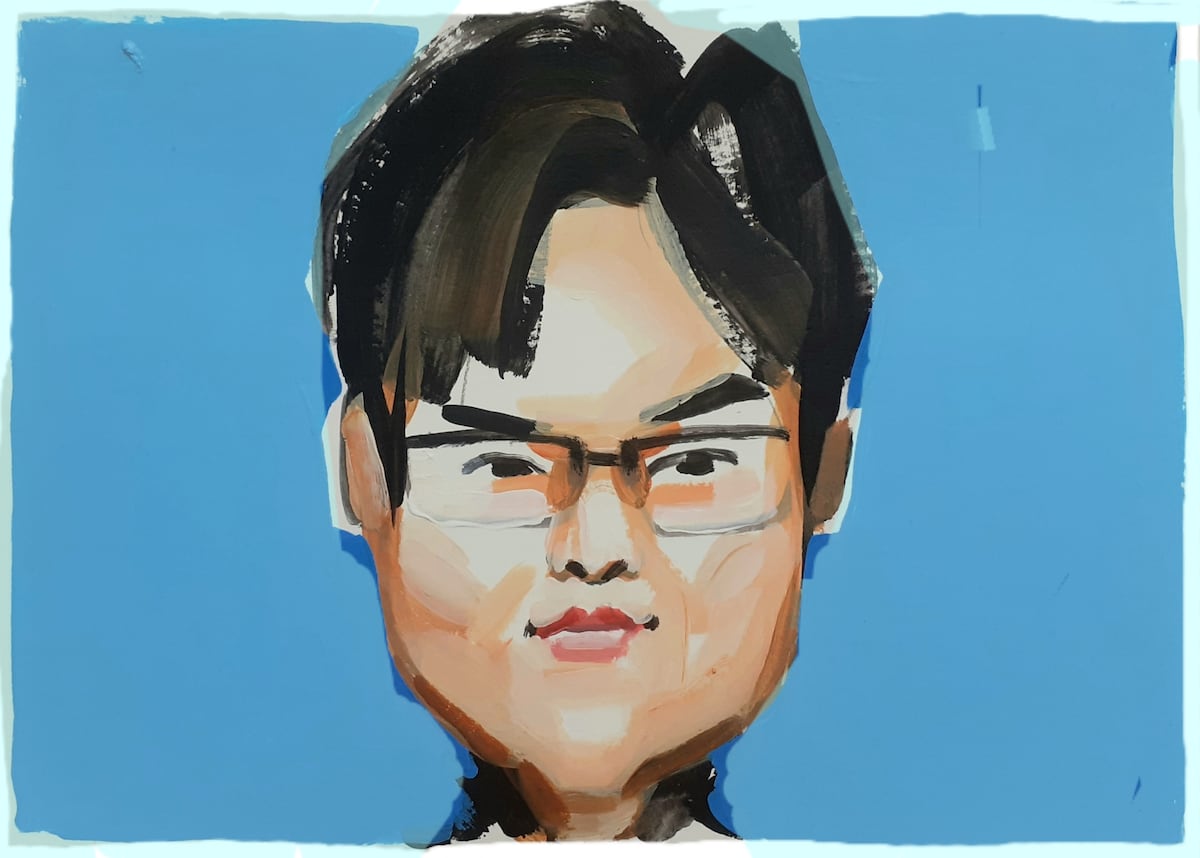
At the age of 34, the innovator behind Moonshot has introduced a groundbreaking model that reduces the competitive gap between China and the United States in the realm of artificial intelligence.
There are transformative books that leave a lasting impact on individuals—and even nations. If China ultimately surpasses the United States in AI leadership, part of the credit might go to famed Japanese author Haruki Murakami. His character inspired Yang Zhilin, who is now the driving force behind Moonshot AI—a firm that is propelling China closer to gaining the upper hand in AI technology, all while the melodies of Pink Floyd’s "The Dark Side of the Moon" play in the background.
With the launch of its latest AI model, Kimi K3, Moonshot has created a ripple effect in Silicon Valley. This model boasts capabilities comparable to leading U.S. systems from OpenAI and Anthropic but comes at a more accessible price point. What sets Kimi K3 apart from its American counterparts is its open-weight architecture—the largest ever released—allowing users to download and modify it without charge. "It's a pretty good model," remarked Greg Brockman, OpenAI's president, adding to concerns about the current AI landscape.
The implications of this advancement were felt on Wall Street, where the PHLX Semiconductor Index dipped into bear-market territory. Once again, a Chinese AI model was poised to challenge U.S. technological preeminence despite continual efforts to curb its progress. The response to such challenges often involves innovation. With U.S. restrictions on advanced semiconductor exports, focus has shifted to enhancing domestic production and improving algorithmic efficiency, ensuring systems operate effectively with fewer resources. A few months prior, Anthropic CEO Dario Amodei suggested that Chinese AI models were lagging six to twelve months behind their U.S. counterparts, but those assessments may need a fresh review.
At the center of this buzz is Yang, who, despite his youthful appearance, has reshaped the AI landscape. His journey is not one driven by the pressure of a cutthroat educational system or overbearing parents; instead, it reflects a young man given the freedom to explore his passions—whether as a potential rock star or a wandering poet. "I made almost every important decision in my life myself," he shared during a 2020 interview with Sohu.
After winning regional coding competitions, Yang gained admission to Tsinghua University in Beijing, which is also the alma mater of President Xi Jinping. He excelled in the university’s rigorous admission process as well as China’s challenging gaokao national exam. Initially focused on thermal engineering, two years later, he decided to shift to computer science, inspired by a character from a Murakami novel. The exact story eludes him, but it ignited his passion for technology's capability to effect change.
"Everything that happened afterwards convinced me that transferring to the Computer Science Department was the most important and correct decision I’ve ever made," he reflected later.
His university years were also marked by creativity beyond coding; Yang formed a band called Splay, where he played drums and composed songs. The group's name was derived from a self-adjusting data structure, embodying the tension between societal demands and personal expression.
In 2015, Yang moved to the U.S. to pursue a doctorate at Carnegie Mellon University, studying under luminaries in AI like Ruslan Salakhutdinov and William W. Cohen. "He is absolutely brilliant," said Salakhutdinov of his former student.
Yang completed his doctorate in just four years, publishing significant research in machine learning while interning at tech giants like Google and Meta. Although he could have stayed in the U.S. tech hub, he felt the pull to return to China to launch his enterprise.
“I remember him saying that if he didn’t at least try starting his own company, he would regret it for the rest of his life,” recounted his mentor, who respected his bold decision.
The launch of ChatGPT in 2022 ignited a mix of frustration and excitement in Yang—frustration at not being part of such a groundbreaking development and excitement at its potential. That same year, he traveled back to the U.S. to evaluate the market and convinced himself he could secure $100 million to start his venture.
In March 2023, he established Moonshot, whose Chinese name references one of Pink Floyd's iconic songs. He successfully raised nearly $300 million, primarily from Chinese backers, and Bloomberg reports that the company is currently valued at over $31 billion. Supported by major players like Alibaba and Tencent, Moonshot aims to leverage the momentum created by its new model, possibly preparing for a public offering with aspirations of achieving a $50 billion valuation.
Yang’s aspirations extend beyond immediate financial metrics; he is focused on how AI will transform the world in the next two decades. "When artificial general intelligence is achieved, or even a superior form of intelligence, everything that exists today will be rewritten," he stated in a 2024 Tencent News interview.
While he continues to develop applications and services, he believes that true artificial general intelligence, capable of performing any task, is the ultimate goal for the next ten years. He encounters this technology with optimism, viewing it as a catalyst for humanity’s advancement.
Reflecting on his earlier dreams of prosperity through entrepreneurship, Yang penned a song about envisioning a successful startup, which serves as a reminder not to let materialism overshadow his aspirations.
While navigating the unpredictable landscape of technology, Yang remains realistic about success and failure. "I accept the possibility of failure. It’s not that important," he expressed in an interview. "This has already completely changed my life, and I’m very grateful."
Yet, in his journey towards ambitious milestones, he maintains an awareness of the ground beneath him.
Shortly after Kimi K3's release, Michael Kratsios, director of the White House Office of Science and Technology Policy, leveled allegations against Moonshot, claiming it had acquired Nvidia chips in violation of U.S. export restrictions and had purportedly "distilled" Anthropic's model for its own training purposes.