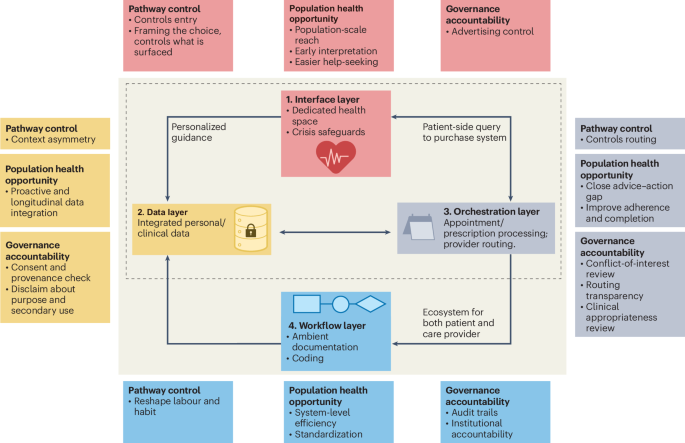
Consumer AI is gradually transforming the landscape for one of healthcare's most crucial participants: the patient. What once seemed like a distant vision of more knowledgeable and engaged patients is now becoming commonplace. Individuals are increasingly turning to AI tools to gain insights into symptoms, evaluate treatment options, decode complex medical jargon, and navigate the intricacies of insurance—all before they even engage with health providers or insurers.
This shift necessitates a new operational paradigm for healthcare organizations, which are now grappling with patients whose expectations surpass what current systems are equipped to deliver.
According to OpenAI, over 5% of ChatGPT communications worldwide pertain to healthcare, with U.S. users sending between 1.6 to 1.9 million weekly messages focused on health insurance topics such as plan comparisons, claims management, pricing, eligibility, billing, and cost-sharing. Patients are not merely inquiring about potential symptom meanings; they are actively seeking guidance on how to manage the business aspects of healthcare.
Understanding the Evolving Patient Demographic
To grasp the implications of this transformation, I spoke with Ganesh Padmanabhan, CEO and co-founder of Autonomize AI.
“The real disruption lies not in the emergence of AI-informed patients, but rather in the insights these patients bring to light about the healthcare operating model,” Padmanabhan noted. “The pace of patient intelligence is outstripping that of system intelligence.”
This perspective highlights that the challenge isn't merely that patients are adopting consumer AI; rather, it's that healthcare frameworks are insufficiently prepared to handle the complexity and expectations that accompany more knowledgeable patients. Another issue is time allocation. Currently, a significant portion of clinical interactions is consumed by administrative duties, allowing precious little time for direct patient engagement. This is an area where AI can change the dynamics.
Human Interaction Remains Essential
A recent survey from Prosper Insights & Analytics revealed that 84% of U.S. adults prefer speaking with a live representative rather than an AI chatbot when dealing with healthcare issues, while only 16% opt for AI assistance. Interestingly, younger generations are more amenable to AI, with 23.7% of Millennials and 23.1% of Gen Z choosing AI chat for healthcare queries, compared to a mere 5.2% of Boomers.
When presented with a definition, only 17.6% of respondents considered autonomous AI a favorable concept. Meanwhile, 40.6% remained uncertain, and 41.8% outright disagreed.
Furthermore, the Prosper data indicates that 40.4% of adults believe AI requires human supervision, 40.3% express concern about the potential for incorrect information from AI, and 32.5% desire greater transparency regarding the data AI utilizes.
Privacy concerns loom large as well, with 60% of respondents indicating they are either extremely or very worried about AI's handling of their personal data.
Trust and Information Quality Are Key
A 2025 study published in Digital Health emphasizes that trust in AI-generated health information significantly influences users’ willingness to utilize that information, with quality emerging as the foremost factor for establishing trust. In the healthcare sector, this finding serves as both a caution and a guide. As AI-generated data shapes patient actions, the emphasis must be on the quality, transparency, and contextual relevance of that information.
The Role of Operational AI
This scenario underscores the importance of operational AI, which is designed around various fields of expertise. Healthcare workflows encompass a wide array of knowledge, including clinical protocols, payer guidelines, patient histories, pharmaceutical information, documentation standards, coding, benefits, and care management. Currently, these components often reside in different systems and departments. A multi-agent approach could facilitate the integration of these elements, enabling healthcare providers to focus on delivering care without the need to manually reconstruct context.
Ideally, when a physician engages with a patient, relevant histories, policy contexts, documentation needs, and necessary administrative steps should already be available. If authorization is required, that should commence alongside other processes. If a care gap is detected, it should be flagged. In cases where a patient's questions stem from incomplete or erroneous AI interpretations, clinicians should quickly have the context needed to clarify.
Padmanabhan emphasizes, “AI should not create additional layers between healthcare professionals and patients. The most effective operational AI is often invisible: a sophisticated system that organizes critical information, initiates appropriate processes, and removes operational barriers before they disrupt patient care.”
As patients increasingly utilize AI to manage their health, the role of human clinicians becomes ever more vital. Their value lies not in hunting for information across disparate systems, but in providing insight, judgment, trust, and meaningful dialogue.
The AI-Enhanced Patient is Here to Stay
For healthcare executives, the emergence of consumer AI is not a distant prospect; it is a current reality. Patients are actively employing these technologies to investigate symptoms, explore treatment options, and address coverage queries, arriving with heightened expectations before consultations with healthcare providers.
While many healthcare providers are enhancing their digital interfaces and self-service functionalities, a more significant challenge persists internally: ensuring that clinical, administrative, and operational teams are equipped to handle a more informed consumer without adding friction or risking burnout among caregiving personnel.
The AI-empowered patient is already part of the healthcare landscape. It’s time for healthcare systems to adapt and meet these patients on their terms.
Note: The consumer sentiment study referenced earlier was conducted by Prosper Insights & Analytics, utilizing the same dataset leveraged by the National Retail Federation and accessible through Amazon Web Services, Bloomberg, and the London Stock Exchange Group for economic benchmarking.