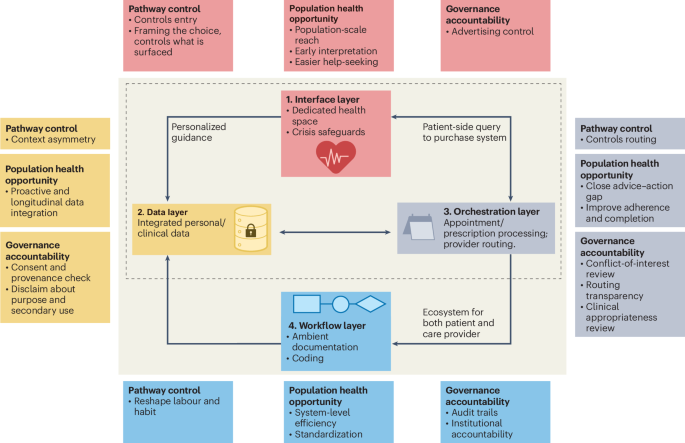
Consumer-facing AI can improve public health—but more evidence is needed. Nat. Health 1, 159 (2026).
Plantin, J. -C., Lagoze, C., Edwards, P. N. & Sandvig, C. Infrastructure studies meet platform studies in the age of Google and Facebook. New Media Soc. 20, 293–310 (2018).
OpenAI. Introducing ChatGPT Health. https://openai.com/index/introducing-chatgpt-health/ (2026).
Staff, T. Perplexity health connects medical records and wearables in new AI push. TechRepublic https://www.techrepublic.com/article/news-perplexity-health-ai/ (2026).
Amazon. Introducing Health AI | Personalized insights, human-powered care. Amazon Health AI https://health.amazon.com/health-ai/learn-more
Microsoft. Copilot for Health: your AI Assistant. Microsoft Copilot https://www.microsoft.com/en-us/microsoft-copilot/for-individuals/do-more-with-ai/ai-for-daily-life/copilot-for-health-your-ai-companion-for-smarter-medical-decisions
Ant Group. Ant Group announces major upgrades to its 15-million-MAU AI health app AQ amid wider push into health sector. https://www.antgroup.com/en/news-media/press-releases/1765779300000 (2025).
South China Morning Post. Ant’s AQ health app tops 100 million users amid holiday surge. https://www.scmp.com/tech/article/3344359/ants-aq-health-app-breaks-through-100-million-users-amid-holiday-surge (2026).
Anthropic. Transform healthcare from insight to action. Healthcare | Claude by Anthropic https://claude.com/solutions/healthcare
Mandl, K. D. How AI could reshape health care—rise in direct-to-consumer models. JAMA 333, 1667–1669 (2025).
Lutes, M. E, & Hughes, R. IV. When the front door is an algorithm: guiding consumer use of AI in health care. Health Affairs Forefront https://doi.org/10.1377/forefront.20260302.877526 (2026).
Adler-Milstein, J., Murray, S. G. & Wachter, R. M. The market dynamics for third-party AI tools trying to compete with electronic health record developers. JAMA https://doi.org/10.1001/jama.2026.2394 (2026).
DataReportal. Digital 2026: Global Overview Report — Global Digital Insights. https://datareportal.com/reports/digital-2026-global-overview-report (2025).
Hwang, Y. -M., Ng, M. Y., Pillai, M., Sahai, M. P. & Hernandez-Boussard, T. The landscape of AI implementation in US hospitals. Nat. Health 1, 99–112 (2026).
Rutunda, S. et al. Large language models for frontline healthcare support in low-resource settings. Nat. Health 1, 191–197 (2026).
International Telecommunication Union. Measuring digital development: facts and figures 2025. https://www.itu.int/hub/publication/d-ind-ict_mdd-2025-3/ (2025).
Nimo, C. et al. AfriMed-QA: a pan-african, multi-specialty, medical question-answering benchmark dataset. in Proceedings of the 63rd Annual Meeting of the Association for Computational Linguistics (Volume 1: Long Papers) (eds. Che, W. et al.) 1948–1973 https://doi.org/10.18653/v1/2025.acl-long.96 (Association for Computational Linguistics, 2025).
Ahia, O. et al. Do all languages cost the same? Tokenization in the era of commercial language models. in Proceedings of the 2023 Conference on Empirical Methods in Natural Language Processing (eds. Bouamor, H. et al.) 9904–9923 https://doi.org/10.18653/v1/2023.emnlp-main.614 (Association for Computational Linguistics, 2023).
Designated Health Professional Shortage Areas Statistics. Third Quarter of Fiscal Year 2026 Designated HPSA Quarterly Summary. https://data.hrsa.gov/Default/GenerateHPSAQuarterlyReport/?utm_source=openai (2026).
Journal of Urgent Care Medicine. One Medical: reimaging primary care around the consumer. https://www.jucm.com/one-medical-reimaging-primary-care-around-consumer/ (2016).
Mathis, W. S. et al. Vulnerability index approach to identify pharmacy deserts and keystone pharmacies. JAMA Netw. Open 8, e250715 (2025).
Catalano, G., Khan, M. M. M., Chatzipanagiotou, O. P. & Pawlik, T. Pharmacy accessibility and social vulnerability. JAMA Netw. Open 7, e2429755 (2024).
Fernández, E. V., Mcdaniel, J. & Carroll, N. Examination of the link between medication adherence and use of mail-order pharmacies in chronic disease states. J. Manag. Care Spec. Pharm. 22, 1247–1259 (2016).
Wang, X., Seyler, B. C., Han, W. & Pan, J. An integrated analysis of spatial access to the three-tier healthcare delivery system in China: a case study of Hainan Island. Int. J. Equity Health 20, 60 (2021).
Ye, P. et al. National-scale 1-km maps of hospital travel time and hospital accessibility in China. Sci. Data 11, 1130 (2024).
Du, X., Du, Y., Zhang, Y., Zhu, Y. & Yang, Y. Urban and rural disparities in general hospital accessibility within a Chinese metropolis. Sci. Rep. 14, 23359 (2024).
Huang, M. et al. Primary care quality and provider disparities in China: a standardized-patient-based study. Lancet Reg. Health West. Pac. 50, 101161 (2024).
Xu, J., Powell-Jackson, T. & Mills, A. Effectiveness of primary care gatekeeping: difference-in-differences evaluation of a pilot scheme in China. BMJ Glob. Health 5, e002792 (2020).
Huisman, L. et al. A digital mobile health platform increasing efficiency and transparency towards universal health coverage in low- and middle-income countries. Digit. Health 8, 20552076221092213 (2022).
Lucyk, K., Tang, K. & Quan, H. Barriers to data quality resulting from the process of coding health information to administrative data: a qualitative study. BMC Health Serv. Res. 17, 766 (2017).
Chernew, M. & Mintz, H. Administrative expenses in the US health care system: why so high?. JAMA 326, 1679–1680 (2021).
Yan, A. S., Apathy, N. C. & Chen, J. Adoption of health information technologies by area socioeconomic deprivation among US hospitals. JAMA Health Forum 6, e253035 (2025).
Adler-Milstein, J. & Jha, A. K. HITECH Act drove large gains in hospital electronic health record adoption. Health Affairs 36, 1416–1422 (2017).
Chishtie, J. et al. Use of epic electronic health record system for health care research: scoping review. J. Med. Int. Res. 25, e51003 (2023).
Wong, A. et al. External validation of a widely implemented proprietary sepsis prediction model in hospitalized patients. JAMA Intern. Med. 181, 1065–1070 (2021).
Capoot, A. Epic Systems is building more than 100 new AI features for doctors and patients. Here’s what’s coming. CNBC https://www.cnbc.com/2024/08/21/epic-systems-ugm-2024-ai-tools-in-mychart-cosmos-.html (2024).
Everson, J., Nong, P. & Richwine, C. Uptake of generative AI integrated with electronic health records in US hospitals. JAMA Netw. Open 8, e2549463 (2025).
Nong, P., Adler-Milstein, J., Apathy, N. C., Holmgren, A. J. & Everson, J. Current use and evaluation of artificial intelligence and predictive models in US hospitals. Health Affairs 44, 90–98 (2025).
Arora, R. K. et al. HealthBench: evaluating large language models towards improved human health. Preprint at https://doi.org/10.48550/arXiv.2505.08775 (2025).
Hicks, R. S. et al. HealthBench Professional: evaluating large language models on real clinician chats. Preprint at https://doi.org/10.48550/arXiv.2604.27470 (2026).
OpenAI. Making ChatGPT better for clinicians. https://openai.com/index/making-chatgpt-better-for-clinicians/ (2026).
Bulusu, P. Amazon launches Health AI agent on Amazon website and app with free 24/7 access to virtual care for Prime members. Amazon News https://www.aboutamazon.com/news/retail/amazon-health-ai-agent-one-medical/ (2026).
Businesswire. Ant Group launches major campaign against health misinformation via AI healthcare app AQ amid wider healthcare push. https://www.businesswire.com/news/home/20250818527127/en/Ant-Group-Launches-Major-Campaign-Against-Health-Misinformation-via-AI-Healthcare-App-AQ-Amid-Wider-Healthcare-Push/ (2025).
Anthropic. Advancing Claude in healthcare and the life sciences. https://www.anthropic.com/news/healthcare-life-sciences/ (2026).
Ramaswamy, A. et al. ChatGPT Health performance in a structured test of triage recommendations. Nat. Med. https://doi.org/10.1038/s41591-026-04297-7 (2026).
Center for Devices and Radiological Health. Clinical Decision Support Software. https://www.fda.gov/regulatory-information/search-fda-guidance-documents/clinical-decision-support-software/ (2026).
Mello, M. M. & Cohen, I. G. Regulation of health and health care artificial intelligence. JAMA 333, 1769–1770 (2025).
Wang, M. Q. The ethics of Ant Afu: health AI within China’s super-app ecosystem. J. Med. Ethics https://blogs.bmj.com/medical-ethics/2026/01/30/the-ethics-of-ant-afu-health-ai-within-chinas-super-app-ecosystem/ (2026).
Sekalala, S. & Chatikobo, T. Colonialism in the new digital health agenda. BMJ Glob. Health 9, e014131 (2024).
Garg, S., Bebarta, K. K. & Tripathi, N. The Ayushman Bharat Pradhan Mantri Jan Arogya Yojana (AB-PMJAY) after four years of implementation - is it making an impact on quality of inpatient care and financial protection in India?. BMC Health Serv. Res. 24, 919 (2024).
Belenguer, L. AI bias: exploring discriminatory algorithmic decision-making models and the application of possible machine-centric solutions adapted from the pharmaceutical industry. AI Ethics 2, 771–787 (2022).
World Health Organization. Ethics and governance of artificial intelligence for health. https://www.who.int/publications/i/item/9789240029200/ (2021).
Pan, J. et al. COMPASS-GH is a consensus roadmap for defining standards for safe, accurate and equitable AI in general health queries. Nat. Health 1, 162–163 (2026).
Glasgow, R. E., Vogt, T. M. & Boles, S. M. Evaluating the public health impact of health promotion interventions: the RE-AIM framework. Am. J. Public Health 89, 1322–1327 (1999).
Wang, H. et al. An evaluation framework for ambient digital scribing tools in clinical applications. NPJ Digit. Med. 8, 358 (2025).
Collins, G. S. et al. TRIPOD+AI statement: updated guidance for reporting clinical prediction models that use regression or machine learning methods. BMJ 385, e078378 (2024).
World Health Organization. Global strategy on digital health 2020–2025. https://www.who.int/publications/i/item/9789240020924/ (2021).
Greenhalgh, T. et al. Beyond adoption: a new framework for theorizing and evaluating nonadoption, abandonment, and challenges to the scale-up, spread, and sustainability of health and care technologies. J. Med. Int. Res. 19, e8775 (2017).
Torabi, F. et al. A common framework for health data governance standards. Nat. Med. 30, 26–29 (2024).
Shaw, J. & Sekalala, S. Health data justice: building new norms for health data governance. NPJ Digit. Med. 6, 30 (2023).
World Bank Group. Implementation know-how brief. Data governance in health. https://documents1.worldbank.org/curated/en/099081723223522777/pdf/P175075036726f0a00832307b7ae23a06a6.pdf (2025).
China Government Website. National Internet Information Office. Interim measures for the management of generative AI services. https://www.gov.cn/zhengce/zhengceku/202307/content_6891752.htm (2023).
Omar, M. et al. Multi-model assurance analysis showing large language models are highly vulnerable to adversarial hallucination attacks during clinical decision support. Commun. Med. 5, 330 (2025).
Omiye, J. A., Lester, J. C., Spichak, S., Rotemberg, V. & Daneshjou, R. Large language models propagate race-based medicine. NPJ Digit. Med. 6, 195 (2023).
Obermeyer, Z., Powers, B., Vogeli, C. & Mullainathan, S. Dissecting racial bias in an algorithm used to manage the health of populations. Science 366, 447–453 (2019).
Wu, E. et al. How medical AI devices are evaluated: limitations and recommendations from an analysis of FDA approvals. Nat. Med. 27, 582–584 (2021).
Grundy, Q. et al. Data sharing practices of medicines related apps and the mobile ecosystem: traffic, content, and network analysis. BMJ https://doi.org/10.1136/bmj.l920 (2019).