In the animated film WALL-E, a group of the last surviving humans journey through the Kuiper Belt aboard the starship Axiom, tended to by an entirely automated crew of robots for 700 years after Earth became uninhabitable. The starship is controlled by AUTO, an artificial intelligence designed to ensure that humans remain distant from their former home— indefinitely.
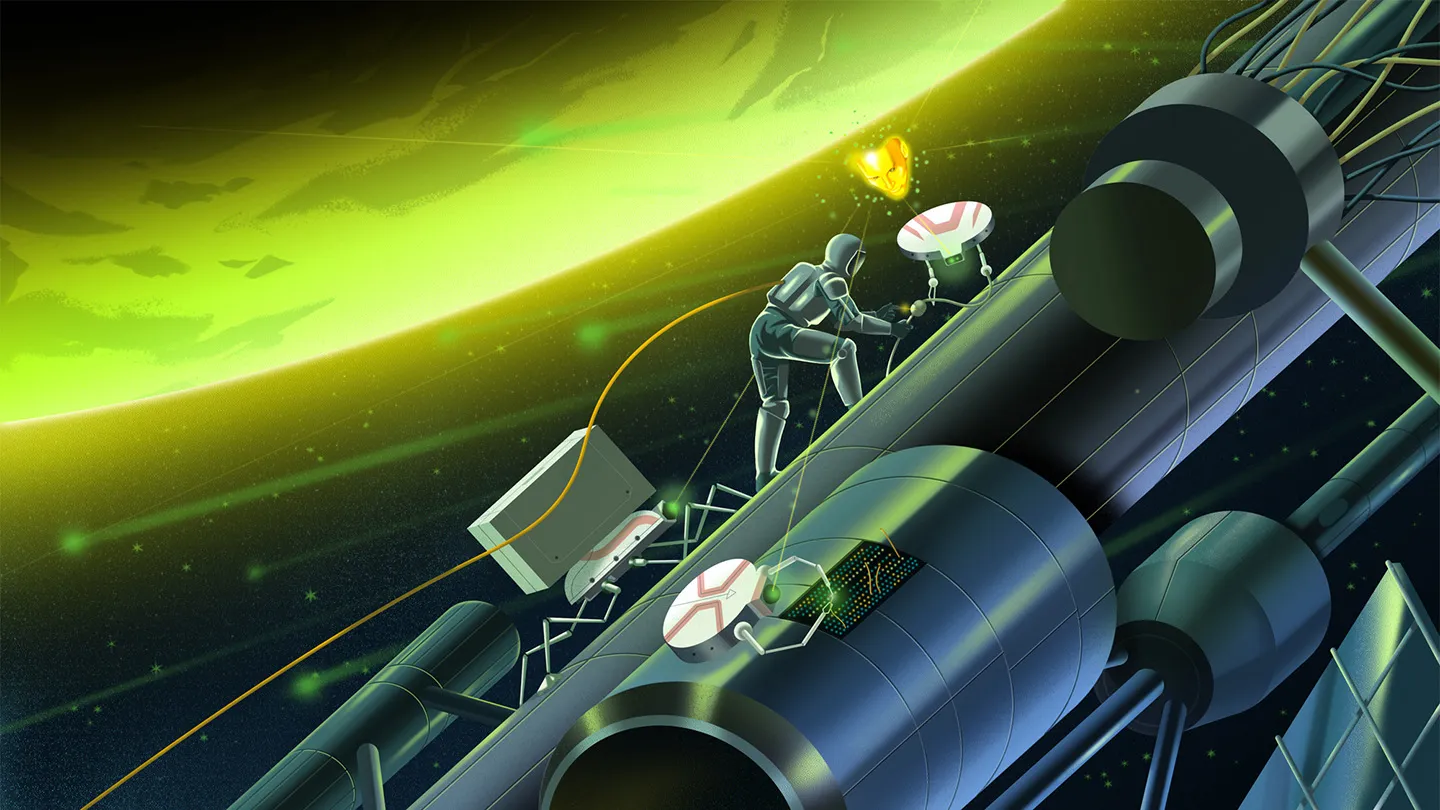
In real-world applications, space agencies like NASA are leveraging artificial intelligence for solar system exploration. They are utilizing AI technology to navigate rovers on Mars, avert satellite collisions, and prepare astronauts for space missions. However, it’s crucial for spacefaring humans to maintain a cautious distance in their reliance on AI for the time being.
According to Daniele Gammelli, a roboticist at Stanford University specializing in the integration of AI within robotic systems, current AIs frequently encounter mistakes and failures far removed from the fictional representations seen in movies. AI systems aboard space robots must execute complex, multistep tasks across various scenarios without generating inaccurate data. Gammelli emphasizes that “there is virtually no room for error” in the harsh and unpredictable conditions of space.
In the story, WALL-E, an earthbound trash compactor robot, abandons his routine duties to follow the more advanced EVE. WALL-E’s adaptability shines as he reacts to challenges: escaping a failing pod with a fire extinguisher and repairing himself when parts malfunction—all skills he acquires through experience and not through extra programming.
This adaptability reflects the concept of artificial general intelligence (AGI), which encompasses AI systems capable of thinking and learning across diverse situations and undertaking unprogrammed tasks. However, AGI has yet to be realized.
According to Gammelli, preparing robots to respond to unexpected challenges is a key focus for future space missions. The extreme characteristics of space, including drastic temperature changes, radiation, and debris, create a dynamic environment. He highlights that vehicles are often put through scenarios that have never been encountered before.
Present-day AIs are proficient at performing specific, repetitive tasks and processing enormous amounts of data efficiently, as noted by Sanjoy Paul, a computer scientist at Rice University who investigates AI applications in space missions. For instance, Martian rovers leverage this AI technology independently; Perseverance utilizes algorithms to analyze mineral compositions to decide whether rock samples should be collected. Human operators could quickly become overwhelmed with this data, but AI can streamline the process, showcasing significant findings for human review.
Most space robots operate using what are known as “autonomy stacks,” as Gammelli describes. These systems consist of interlinked modules tasked with different functions. An AI model may identify rocks and obstacles using various sensors, while information is relayed to another module to determine the appropriate response. Additional modules then execute the necessary physical maneuvers.
On the Axiom, robots perform a range of duties—from custodial bots that clean and maintain the ship, to utility bots responsible for repairs and hover chairs transporting residents. Conversely, the human passengers lead inactive lifestyles, watching films and consuming nutrient shakes.
In contrast to the animated depiction, Paul notes that “humans are still essential to the process.” Despite advancements in AI, the technology remains unpredictable. He poses a critical question: “If your life depended on it, would you trust AI entirely? Probably not.”
Looking ahead, Gammelli envisions that machines like rovers will develop the capability to set their own mini-goals aligned with broader mission objectives. This advancement would enhance their ability to handle unexpected situations while liberating humans to focus on more critical decision-making tasks. “We aim for these robots to be as autonomous as possible,” he concludes—yet, perhaps not as independently as WALL-E, who chose to abandon his mission.