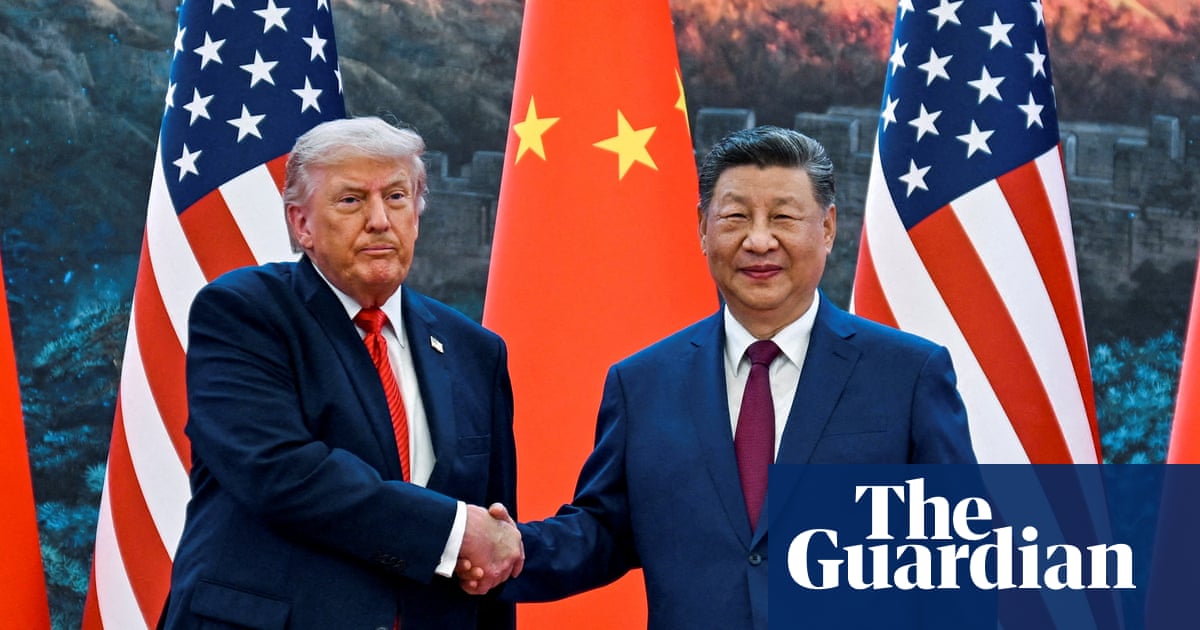
When Xi Jinping, leader of China, arrives in Maryland on Wednesday, he will be greeted by a warm reception—possibly even a hug, according to the hopes of Donald Trump—marking a notable shift in US-China relations under the current leadership compared to recent administrations.
This meeting will be the second face-to-face encounter this year between the leaders of the world's two largest economies, coming after their initial discussions in May in Beijing. During that summit, both leaders expressed a desire to foster "strategic stability" between their countries; however, tangible results were lacking, with ongoing disputes over trade, export limitations, and geopolitical matters persisting.
Despite the friendly atmosphere from the earlier meeting, expectations are muted for meaningful advancements during Xi's first official visit to the US since 2015. Bonnie Glaser, managing director at the German Marshall Fund, stated, “Expectations are very low,” noting that the term “deliverables” is rarely being mentioned.
One potential area for agreement between Trump and Xi could be artificial intelligence safety. A number of prominent tech leaders, including Jeff Bezos, Sundar Pichai, Sam Altman, Tim Cook, Elon Musk, Mark Zuckerberg, and Jensen Huang, are expected to be present at a state dinner at the White House on Thursday night.
Trump has recently voiced concerns about the rapid advancement of AI and emphasized the importance of the US maintaining its lead over China in this critical technology sector. “We’re leading China in AI,” he remarked. “Frankly, I want to keep it that way, because whoever wins AI, wins.”
This past Sunday, Scott Bessent, the US Treasury Secretary, met with Chinese Vice Premier He Lifeng and proposed establishing an AI safety framework to strengthen collaboration between Washington and Beijing. However, this proposal appears limited in scope, lacking a major safety agreement.
In a recent article, China's state-run People’s Daily advocated for a cooperative approach to AI, suggesting it as a promising avenue for US-China collaboration. António Guterres, the UN Secretary-General, echoed these sentiments, urging both nations to create channels for dialogue akin to those seen during the Cold War era.
Nevertheless, China contests US claims regarding the existential threat posed by its AI advancements. The Chinese foreign ministry pushed back against an essay that advocated for US restrictions on Chinese AI development, asserting that “fearmongering, confrontation, and vicious competition” would only hinder global AI governance efforts.
Beijing has taken measures to regulate AI development, including requiring the labeling of AI-generated content and placing restrictions on children’s use of AI companions, in alignment with the Chinese Communist Party's goals of information control.
The trade issue remains ever-present, with a temporary truce in the trade war initiated last year during talks in South Korea set to expire in November. Beijing desires a long-term suspension of tariffs that threaten its export-reliant economy, but the US is reportedly hesitant to agree to terms that might undermine its negotiating power.
Glaser pointed out, “The US side views this as leverage over China and ensuring that they can get deliveries of the rare earths and magnets that American companies need.” Despite the ongoing trade tensions, China’s exports have flourished, heading toward a trade surplus of $1 trillion for the second consecutive year.
Another significant topic that has evolved since their last meeting is Taiwan. Following the May summit, Xi gained a key concession when Trump agreed to temporarily halt a significant package of arms sales to Taiwan—an issue traditionally excluded from US-China discussions. However, Trump has since labeled future arms sales as a “very good negotiating chip,” indicating a potential delay in such sales until after upcoming APEC and G20 summits.
In light of the ongoing geopolitical landscape, experts are cautioning against expectations for significant progress in this summit. Scott Kennedy from the Center for Strategic and International Studies remarked that the US-China relationship is not evolving into a cooperative “G2” dynamic, but rather a more complex engagement strategy.
China remains a leading player in oil trade with Iran, and while it has put pressure on Tehran to negotiate in light of US strikes, its overall influence in mediating the Middle East crisis has been limited. Similarly, China's unwavering support for Russia throughout the ongoing Ukraine conflict emphasizes its position as a stabilizing force in contrast to the US’s ongoing challenges in the region.
With the divergent approaches of both nations, the upcoming summit is expected to yield minimal concrete outcomes. Amanda Hsiao suggested that the talks will maintain a façade of cordiality but lack substantive ambition.
Democratic voices in Washington have expressed concerns over the domestic implications of Trump’s potentially conciliatory stance toward Xi, with Senator Tammy Duckworth highlighting the need for the president to address human rights issues in China seriously. This sentiment illustrates anxieties that Trump's diplomatic overtures may overshadow pressing concerns regarding Chinese coercive practices.