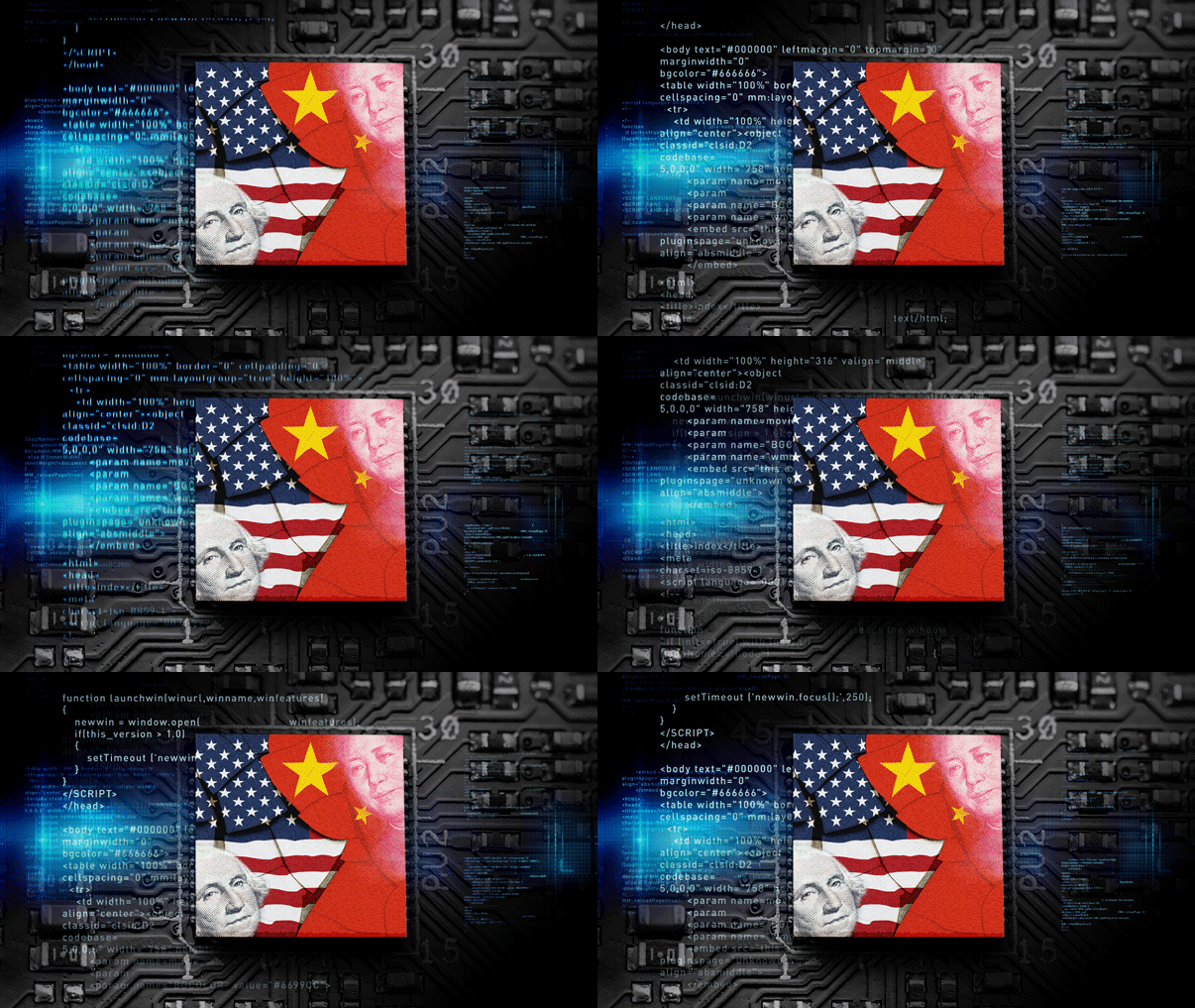
As discussions intensify regarding the emerging realm of artificial intelligence and its implications, experts caution that China is cleverly eroding the United States' global dominance through strategic AI maneuvers, even as President Xi Jinping prepares for his visit to the U.S. this week. The paradigm shift involves a subtle, three-tiered strategy that encompasses extracting knowledge from advanced American AI systems, sabotaging U.S. developers with free open-source alternatives, and ultimately transforming these technologies into tools of cognitive warfare.
Analysts warn that China’s aggressive tactics involve circumventing immense investments made by U.S. research institutions. They exploit advanced American AI frameworks to replicate and enhance their capabilities, all while saturating the market with accessible alternatives. Leah Siskind, an AI research fellow at the Foundation for Defense of Democracies, remarked, “I believe framing this as a ‘race’ is misleading. It resembles a multi-front conflict – we face victories in some arenas but setbacks in others.”
While major American tech companies have invested heavily in building proprietary, high-cost systems, China has taken a markedly different approach by spreading free, open-source AI models worldwide. Siskind cautioned that the financial advantage of utilizing cost-effective Chinese solutions leads some Fortune 500 companies to inadvertently open themselves up to risks such as censorship from the Chinese Communist Party (CCP) and potential backdoor vulnerabilities. “How can one compete with free software when American technology is prohibitively expensive?" she questioned. "Ensuring that a Chinese open-source model is genuinely free of CCP influence is virtually impossible, and that uncertainty is intentional.”
Gordon Chang, a China specialist, highlighted that Beijing is employing these free models as part of a broader economic strategy reminiscent of its earlier maneuvers within the solar panel industry. He believes China aims to undercut American models on cost and availability to ultimately achieve global supremacy in AI.
To successfully flood the market with these free solutions, China first requires access to advanced technologies and a way to overcome the significant lead the U.S. holds in computing infrastructure. Currently, the U.S. boasts over 5,400 data centers compared to around 450 in China and has far superior semiconductor technology. To overcome these challenges, Siskind stated that Chinese research facilities are utilizing a technique known as “knowledge distillation.” This involves smaller models extracting logic and capabilities from larger, more advanced American models, allowing them to make significant strides with minimal investment.
The implications of this technological rivalry are very real. Recently, the Department of Homeland Security issued a cybersecurity advisory, noting that Chinese firms are running "industrial-scale knowledge distillation campaigns" aimed at harvesting proprietary capabilities from leading American AI systems.
Furthermore, experts warn of China’s active integration of AI into critical infrastructure and public influence initiatives. Instead of focusing solely on fantastical notions of "killer robots," Siskind emphasized that China's immediate goal is the physical application of AI—integrating it into factory automation, drones, and autonomous logistics systems.
Chang voiced a concerning prospect about AI-fueled propaganda, which poses a significant threat to American democratic processes. “They excel in cognitive warfare and can amplify these capabilities through artificial intelligence. We cannot allow our electoral outcomes to be influenced by China," he warned.
As Xi Jinping’s imminent U.S. visit unfolds, experts advocate for a concerted response from the White House to address these non-military yet highly pertinent threats with the same urgency reserved for conventional military posturing. Siskind urged that to maintain the U.S.’s technological edge, policymakers should close existing loopholes in chip exports, blacklist foreign labs known for deceptive practices, and foster domestic open-source development that aligns with democratic ideals.
Chang underscored the broader implications of this technological struggle, asserting that Xi Jinping's ambitions echo an imperial mindset that could reshape global governance under Chinese hegemony if left unchecked.
Meanwhile, during a recent address at the United Nations General Assembly, President Donald Trump reaffirmed the U.S. commitment to outpacing China. He announced a shift in terminology, declaring that U.S. government documents would now refer to AI as "superintelligence," emphasizing that the nation remains at the forefront and intends to sustain that lead.