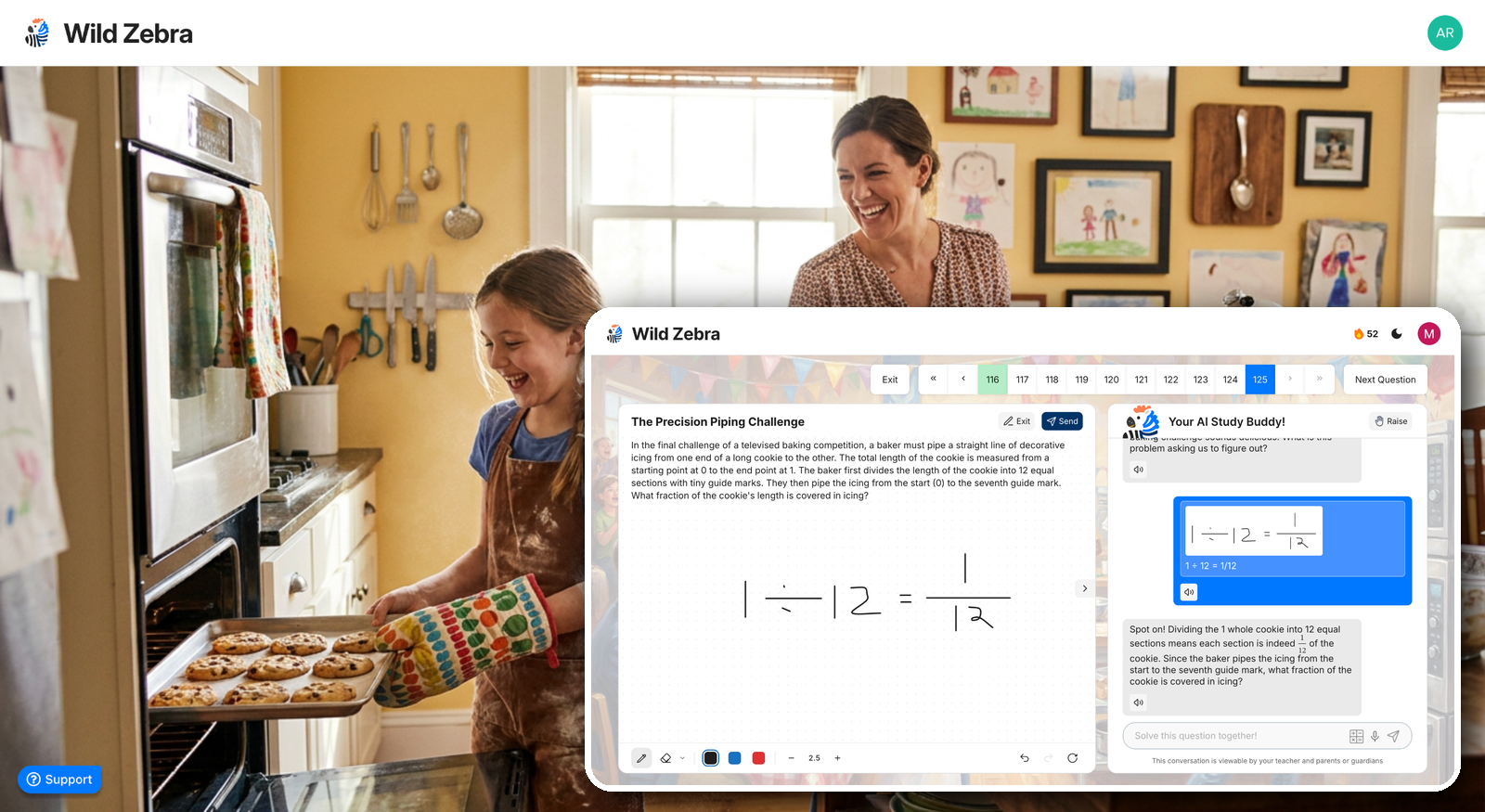
A Seattle-based educational technology startup, Wild Zebra, has successfully secured $6 million in funding to enhance its AI-driven platform designed for teaching math and reading. This funding follows promising initial results indicating that Wild Zebra’s innovative approach can compete effectively with the free educational resources recently launched by major players such as OpenAI, Google, and Anthropic.
What sets Wild Zebra apart is its Socratic method of instruction. Instead of providing direct answers, the AI engages students by guiding them toward the solution through a series of thought-provoking questions, thereby encouraging critical thinking and self-discovery.
Additionally, the lessons on Wild Zebra are tailored to align with students' personal interests, whether that be sports, cooking, music, or other hobbies. This personalization aims to make the learning process more relatable and engaging.
The platform also monitors interactions to pinpoint not just disengagement or distractions but also to celebrate moments of persistence and curiosity, providing valuable insights for teachers and parents through dashboards. “We want to recognize when kids are exhibiting positive behaviors as well,” said Edan Shahar, co-founder and CEO of Wild Zebra.
The recent funding, raised through a notably oversubscribed seed round, was spearheaded by Trilogy Equity Partners with support from Tetherpoint Capital and notable angel investors, including Shrikesh Majithia. This latest investment increases the company's total funding to $8 million.
Co-founded in 2024 by Shahar and AI expert Erik Selberg, Wild Zebra caters to students from grades 2 to 9. With a current team of ten, the startup plans to utilize the new funds primarily for hiring engineers and bolstering sales and marketing strategies.
Amy McCullough, Managing Director at Trilogy and a new board member at Wild Zebra, emphasized the potential for the platform to provide parents and educators with a real-time understanding of each student’s progress and a clear roadmap for their learning journey. McCullough, who initially came to know Shahar through his successful Test Innovators company, was drawn to Wild Zebra’s potential for tracking students’ learning over time.
When Wild Zebra was first highlighted by GeekWire last year, competitors like OpenAI and Google had just unveiled their own educational tools. Recently, Anthropic released a free version of its AI, Claude, tailored for K-12 teachers, while Khan Academy’s own AI, Khanmigo, has been in use for several years.
Shahar commented on the limitations of general-purpose chatbots, which can effectively answer individual questions but lack the ability to track a student's learning progression. In contrast, Wild Zebra employs a unique “learning tree” approach that monitors what a student has achieved, identifies gaps, and determines future learning objectives.
As for the competitive landscape, Shahar views the prominent AI labs more as collaborators than adversaries, leveraging their models within Wild Zebra’s framework.
Currently, the startup has expanded its reach to tens of thousands of students, up significantly from 6,000 just a year ago, and has facilitated hundreds of thousands of tutoring sessions. Families can subscribe to the platform for $48 per month per child, with initial users primarily being parents from pilot schools eager to enroll their other children.
On the institutional side, Wild Zebra collaborates with E3n, an organization formed from the merger of the Educational Records Bureau and the Enrollment Management Association, which serves selective private schools. The ERB invested in Wild Zebra in 2024, utilizing its exam data to determine each student’s starting level, although not all partnering schools do so.
Preliminary evaluations conducted by E3n with a sample of 722 students have shown notable advancements in math and reading skills, particularly among fifth and sixth graders, boasting gains of four to eight percentage points compared to ERB benchmarks.
While the platform initially focused on private schools, Wild Zebra is now exploring partnerships with charter and public institutions. Shahar noted that schools and students skeptical about incorporating AI tend to shy away from their services, while those who opt in usually share a positive outlook, albeit with an awareness of potential risks.
Among the most common concerns voiced by students is the environmental impact of AI technologies. Shahar admitted that while he acknowledges the risks associated with AI, he remains concentrated on exploring its positive potential. “I am not overly optimistic; I recognize the challenges of AI, but my work is focused on maximizing opportunities,” he said.


