The evolution of local AI is rapidly gaining momentum. As AI agents transition from prototype phases to practical applications, open models are shrinking and becoming more efficient to accommodate an increasing number of devices, thus allowing developers to deploy solutions locally.
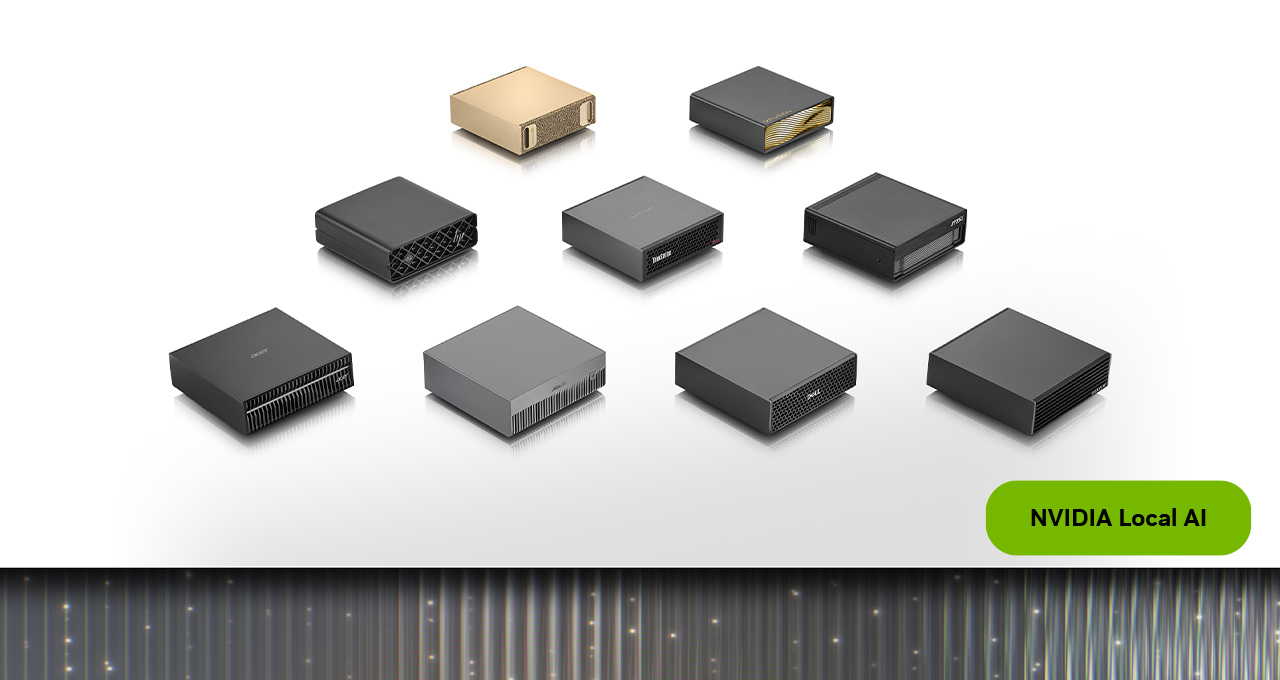
NVIDIA is set to launch its DGX Spark this month, featuring 64GB of unified memory, in collaboration with leading manufacturers like Acer, ASUS, Dell, Gigabyte, HP, and MSI. This solution is tailored for developers, researchers, and AI enthusiasts, offering a comprehensive system equipped with DGX OS and NVIDIA’s AI software stack, ready for immediate use.
This new configuration enables the operation of powerful local agents directly on devices, ensuring privacy without reliance on cloud services. As demands increase, users can easily cluster two units together via NVIDIA Sync Cluster Assistant without the need for complex setups.
Introducing a New Era of Personal AI Supercomputing
The DGX Spark integrates NVIDIA’s Grace Blackwell compute, unified memory, ConnectX-7 networking, and a CUDA-accelerated AI software stack into a single, compact platform. This setup serves as a local AI hub for tasks like inference, fine-tuning, data science, and edge computing.
With this personal AI supercomputer, users can explore various models and utilize their own datasets without the constant need for cloud-based processing.
The new 64GB version remains competitively priced while including the same hardware and software as the higher-capacity 128GB model, supporting models with up to 100 billion parameters fully on the device.
Moreover, when two 64GB units are clustered, performance can reach up to 1.7 times that of a single system, as demonstrated in NVIDIA’s evaluation of the Qwen 3.8 27B test, allowing for continued scalability according to workload needs.
From the first day of launch, DGX Spark is equipped for agent development, supporting NVIDIA Agent Toolkit, CUDA-X AI libraries, Nemotron open models, as well as popular environments like Ollama, vLLM, and PyTorch with CUDA. Developers can quickly transition from powering on the system to executing models in just minutes.
Blender is among the early creator applications slated to support this platform, with an installer soon available for download.
Effortless Scaling with NVIDIA Sync Cluster Assistant
Developers can start with the memory requirements of their current projects and effortlessly scale their systems as their needs grow. The DGX Spark units come with a built-in NVIDIA ConnectX-7 NIC for out-of-the-box connectivity. Two units can join together using a QSFP cable, merging their memory to 128GB and increasing the maximum supported model size to 200 billion parameters, while simultaneously enhancing memory bandwidth and achieving significant performance gains.
The NVIDIA Sync application simplifies the multi-node clustering, automatically detecting connected units, verifying setups, and configuring networking. This allows developers to concentrate on their projects rather than managing infrastructure. Each node operates under the same NVIDIA software stack, eliminating the need for configuration changes when expanding from one to two units.
Additionally, the NVIDIA Sync Model Launcher, arriving later this month, will streamline the process of running local AI. Users can easily download and deploy Qwen3.8 27B on either a standalone DGX Spark unit or a clustered setup, with Sync managing cross-device configurations for user access from laptops.
Practical Applications for DGX Spark Users
The DGX Spark 64GB model is designed for immediate use, accommodating projects from the outset. Users can run extensive models entirely on the device or connect multiple units as required.
Here are three practical scenarios for DGX Spark:
1. **Continuous AI Agent Operation**: Deploy a coding or research agent to continuously execute tasks on DGX Spark, with the option for clustering to enhance capacity for more complex models or multiple simultaneous agents.
2. **Empowering Applications on Regular PCs**: Use DGX Spark to manage inference for language or image models, allowing everyday laptops or desktops to run other applications concurrently without being bogged down.
3. **Scaling for Increased Workload**: When a task exceeds the capabilities of a single unit, users can connect two DGX Spark 64GB systems to pool their resources, allowing workflows that initially ran on one unit to scale effortlessly to two without reconfiguring existing environments.
Starting with DGX Spark
The 64GB DGX Spark will be available from partners like Acer, ASUS, Dell, Gigabyte, HP, and MSI beginning on Friday, October 23, with a starting price of $4,999.
To get started:
1. Download a compatible inference framework such as llama.cpp, Ollama, vLLM, or LM Studio. 2. Obtain the recommended local model tailored to your use case. 3. Connect two units via their NVIDIA ConnectX-7 ports and initiate the NVIDIA Sync Cluster Assistant to automatically configure the network.
For guidance on developing agentic AI on DGX Spark, explore resources like NemoClaw, OpenClaw, Hermes Agent, and OpenShell available at build.nvidia.com.
Additionally, keep an eye on build.nvidia.com/spark for upcoming playbooks, including how to serve LLMs with vLLM and run OpenClaw with a local LLM.
This month, new Windows PCs powered by NVIDIA RTX Spark will also be unveiled from brands such as Acer, ASUS, Dell, HP, Lenovo, Microsoft, and MSI. Sign up for the RTX Spark newsletter to stay updated.
Alibaba’s Qwen-Image-2.1, a lightweight model that merges image generation and editing capabilities, will operate locally on NVIDIA RTX GPUs, DGX Spark, and DGX Station, offering creators more tools to craft and refine their visuals on personal hardware.
For ongoing updates, follow NVIDIA RTX Spark on social media platforms and subscribe to the NVIDIA Local AI newsletter.


