A significant development is unfolding within Israel's high-tech sector as Decart is reportedly in advanced discussions to be acquired by a leading global tech firm for an estimated $6 billion to $7 billion. Sources indicate that negotiations are progressing in their draft stages and may culminate in a signed agreement within the week.
Initially, Nvidia was in talks to acquire Decart, but as the negotiations neared finalization, a new major competitor entered the fray, prompting the company’s founders to reconsider their options.
Speculation among industry insiders suggests that one of the new contenders might be SpaceX, led by Elon Musk. Other potential suitors include Amazon and Nebius, a cloud service provider based in Israel. Notably, the discussions are taking place in the U.S., and Decart has opted not to comment on the situation.
Should the sale proceed, it could profoundly influence Israel's tech ecosystem. If SpaceX becomes the buyer, it could establish its first research and development center in Tel Aviv, leveraging Decart's resources as a foundational base.
Musk has been invested in Decart since 2024, following the launch of Oasis, a game that utilizes Decart’s real-time video generation technology. His enthusiasm was apparent when he shared a "wow" reaction on social media after trying the game, which quickly amassed a million users in just three days, outpacing ChatGPT in downloads.
Continued discussions between Musk and Dean Leitersdorf, one of Decart's co-founders, have persisted since that time. Another connection linking Musk to Decart is Shaun Maguire of Sequoia Capital, who supported Decart since its initial $21 million funding round and is regarded as a close associate of Musk. Maguire played a role in arranging Musk's visit to Israel following the onset of conflict on October 7, during which Musk visited the Gaza border.
Musk has long expressed interest in Israel's tech landscape. Recently, SpaceX raised $75 billion during its IPO, aimed at bolstering its AI infrastructure and advancing the Grok large language model, competing with major players like Anthropic, Google, and OpenAI. Following the IPO, SpaceX acquired AI startup Cursor for $60 billion, suggesting an ongoing push for expanding its computing capabilities. Furthermore, earlier in 2026, Musk integrated xAI into SpaceX, valuing that AI arm at $250 billion.
In the recent public financial disclosure by SpaceX, Musk estimated a potential revenue rate of $100 billion by December, implying significant upward growth. Decart's technology could enhance this strategy by optimizing computing performance on existing hardware.
Amazon's interest in Decart is also noted, though historically, the company has been cautious about massive acquisitions. In April, Amazon made a rare move with an $11 billion acquisition of satellite firm Globalstar, aiming to better compete with SpaceX's Starlink.
Domestically, Decart has demonstrated revenue in the tens of millions, with its growth largely driven by working on projects for semiconductor manufacturers. Previously, Decart was negotiating with Nvidia, which also invested in its latest funding round, but those talks fell through as more lucrative offers emerged.
A potential sale would mark a rapid exit for a company that was founded in 2023 by Leitersdorf and Moshe Shalev, though it may not align with their original aspirations for the company. Just three months ago, Decart secured $300 million in funding, resulting in a valuation around $4 billion, with notable Israeli venture capital firm Aleph now among its investors.
In total, Decart has raised close to $450 million and currently employs about 100 individuals. For investors, a sale in the range of $6 billion to $7 billion would yield substantial returns. Yet, Leitersdorf, a prodigy who earned a doctorate in computer science by age 23, has long articulated ambitions that transcend merely establishing a successful startup.
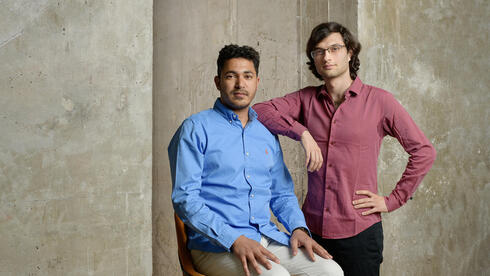
Leitersdorf, at 27, serves as CEO and is joined by 38-year-old Shalev as CPO; the pair's collaborative journey began in IDF Unit 8200. They recently enlisted Yossi Sariel, a former commander of their unit, who retired following the conflict that began on October 7.
Decart stands as one of the few Israeli companies developing its own large-scale AI models, focusing particularly on tech that facilitates real-time video generation. The company's innovative capabilities were highlighted early on when it showcased Oasis, allowing for real-time video generation while enabling a unique virtual reality for each player.
Despite generating revenue swiftly, Decart prioritized not being pigeonholed as a gaming company. Over the past two years, it has sought to pivot towards broader applications for its underlying technology.
Decart's key advantage lies in its ability to produce video at significantly lower costs than competing models, making its technology appealing across the AI landscape. This was bolstered by deepening relationships with chip manufacturers—initially using Nvidia's GPUs, with recent collaborations shifting to Amazon.
The company’s funding journey is indicative of the extraordinary interest it has garnered since inception, securing a $21 million seed round led by Sequoia Capital, followed by further investments shortly thereafter, rapidly elevating its valuation.
From the outset, Leitersdorf's ambitions have been clear. In an interview with Calcalist after Decart was celebrated as the most promising Israeli startup of 2025, both leaders expressed a commitment to building a company capable of addressing monumental challenges and reconfiguring the technological landscape.
Leitersdorf’s vision includes positioning Israel among the top five countries in AI, asserting that only within this scope can Israel become a dominant force in the technological realm.
This ambition makes the potential acquisition particularly relevant. A traditional buyout by a chipmaker or cloud service provider could yield quick financial returns, yet aligning with Musk might give Decart a distinct status in the global tech sphere and usher in a substantial new player into the Israeli market.
Leitersdorf comes from a prominent financial lineage, with family ties that include his brother Yoav, who founded the cybersecurity-focused venture capital firm YL. His early education in computer science at 17 led to advanced degrees, including a postdoctoral fellowship in Singapore.
Conversely, Shalev's background contrasts sharply; he grew up in a Haredi household, later pursued academic qualifications while working, and ultimately served in Unit 8200, where he spent 13 years in various capacities.
Their serendipitous meeting at the base occurred shortly after a major military operation, ultimately leading them to register Decart on September 7, 2023. A month later, both were called to reserve duty amidst ongoing conflict, at a time when their vision for Decart was still forming, centered around groundbreaking advancements in generative artificial intelligence.