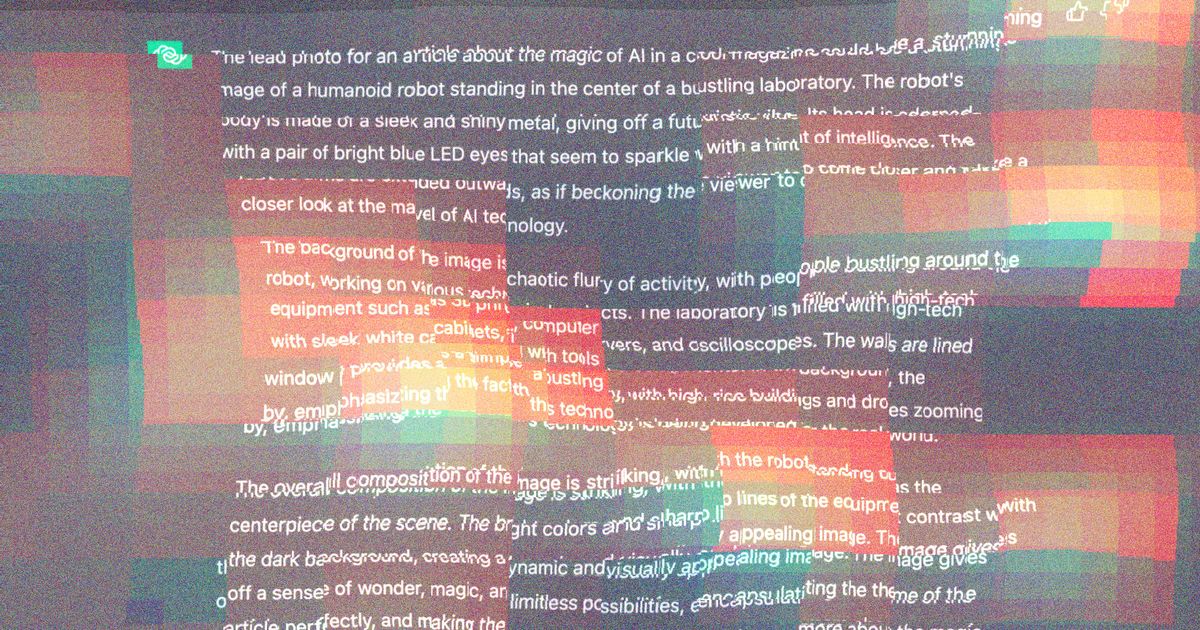
AI-generated content is increasingly permeating the internet, making it challenging to identify its presence on a case-by-case basis. While some outputs, like blatantly copied-and-pasted text from chatbots, are readily apparent, others are more ambiguous. For instance, a student essay may exhibit a strange writing style, a polished avatar might portray a realistic persona, or a disjointed LinkedIn post could either reflect a bot's influence or simply showcase a co-worker's unique writing style.
As we navigate this new landscape of easy AI-generated images, videos, and text, the situation has become chaotic rather than the looming disaster many AI critics had feared. While generated visuals and videos do pose risks in political contexts, their impact has largely been superficial, leading to a pervasive atmosphere of confusion and uncertainty. On various online platforms, automated content resembles a fast-approaching flood of spam, cluttering cultural and commercial spaces. Initial concerns about dangerous deepfakes and targeted misinformation have not fully materialized; instead, we face what could be termed “slopaganda.”
This reality has generated significant backlash, prompting several online platforms to introduce methods for detecting and labeling AI-generated content. Recently, Spotify revealed plans to label AI-generated music, responding to user preferences for transparency. The company noted that listeners find it misleading when they encounter what appears to be a human artist profile only to discover it is entirely fabricated by AI. Additionally, Substack has teamed up with Pangram, an AI-detection tool, allowing users to evaluate text for signs of AI generation. Other companies, including TikTok, YouTube, and Meta, have also implemented labeling systems, while LinkedIn has even created a button designated for content perceived as "AI Slop."
Despite these efforts, they primarily respond to the fallout of a larger issue, limiting their effectiveness. However, some companies are working towards solutions that address the root cause. For example, Google has started incorporating image watermarks in content created with its Gemini tool, while OpenAI and Meta have developed systems to imprint detectable marks on the images generated by their technologies. These measures have intensified under new European Union regulations, which compel generative AI providers to mark their outputs in ways that can be easily recognized as artificially produced. The EU outlines these requirements, stating that developers of chatbots and other AI systems must clearly inform users when interacting with AI, and that generative outputs must be distinguishable as artificially created or altered.
Image watermarks work reasonably well, though they are not foolproof. Determined individuals can often remove or circumvent such markings, and many unrestricted models exist that won’t be subjected to EU regulations or similar oversight. Research has shown that labeling images tends to decrease engagement, indicating that while some users want transparency, they may not always be able to discern what is AI-generated. In a significant development, Anthropic has introduced a durable watermark embedded directly in the text created by its Claude model. This watermark is invisible, does not alter the content's meaning, and travels with the text even after being copied or edited.
For those who frequently engage with AI models, the nuances of such text can be amusing. AI-generated prose often reveals itself through repetitive phrasing, and Anthropic’s Claude is known for its unique and somewhat distinct voice. Some refer to this style as “Claudish,” characterized by a tendency to justify its reasoning rather than simply convey information. However, the ability to embed watermarks directly into generated text is noteworthy and could influence how companies implement similar practices.
While certain individuals openly acknowledge their use of AI when appropriate, complexities arise when AI-generated text is used in contexts where its origins matter, such as academic or professional settings. The prevalence of misrepresentation in early AI applications raises concerns, as many students and professionals may submit AI-generated work without disclosing its source. Although watermarks alone will not instantly resolve issues like academic dishonesty, they could certainly add an intriguing dynamic to the conversation.
Commentator Ben Thompson has argued that the emphasis on watermarking AI outputs is akin to requiring a ballpoint pen to announce its authorship, suggesting that the EU's stance, aligned with input from AI firms, is arbitrary. Long-term challenges remain, particularly as generative AI technologies become increasingly integrated into everyday software. Anthropic's watermarking will extend to various types of text written with Claude, but this could dilute the meaning of marks if applied too broadly or lead to false positives in detection tools.
Even if the technologies currently regulated as AI eventually blend into commonplace tools, it is difficult to equate Claude with a standard ballpoint pen. The nature of AI text generation involves much more complexity and potential for misrepresentation. In the coming years, creators of less-than-authentic content will face three primary strategies: acknowledge their methods and hope audiences are indifferent, seek tools that bypass detection, or potentially cease their misleading practices altogether.