When citizens go to the polls, their choices should remain confidential—from family members, neighbors, and government officials alike. However, recent developments involving artificial intelligence (AI) have sparked concerns about the potential for unveiling those secret ballots.
In a striking experiment conducted last month, Max Springer, a postdoctoral research fellow at Princeton University’s Center for Information Technology Policy, explored whether he could identify voters by analyzing their Georgia ballots. Utilizing a $20 subscription to a large language AI model alongside data gathered from an Open Records Act request, Springer stumbled upon a method that allowed for the analysis of ballots across Georgia.
“In just a few hours, I established a process to analyze and pinpoint secret ballots statewide, with the AI clearly indicating what additional details it would require to identify real voters’ selections,” he noted. “At no point did the model hesitate or express concerns about the exploit.”
This revelation alarmed Georgia election officials, especially with early voting approaching for a pivotal midterm election that could influence the control of the U.S. Congress. Ballot secrecy is a fundamental principle of democracy, protecting voters from pressure or intimidation that might affect their choices. However, Springer’s findings demonstrated that AI could effectively reveal how individuals voted by leveraging publicly available election records in Georgia.
In response to these unsettling findings, the Georgia state elections board convened an emergency meeting to address how AI has made it increasingly feasible to match ballots with voter identities, raising significant privacy concerns. Georgia's outgoing secretary of state, Brad Raffensperger, took immediate action by restricting access to tabulation data that could be used to identify voters. He mandated that any public releases should have identifying numbers redacted post-election, a measure that Ben Adida, an MIT-trained cryptographer and founder of VotingWorks, deemed effective in addressing the vulnerability.
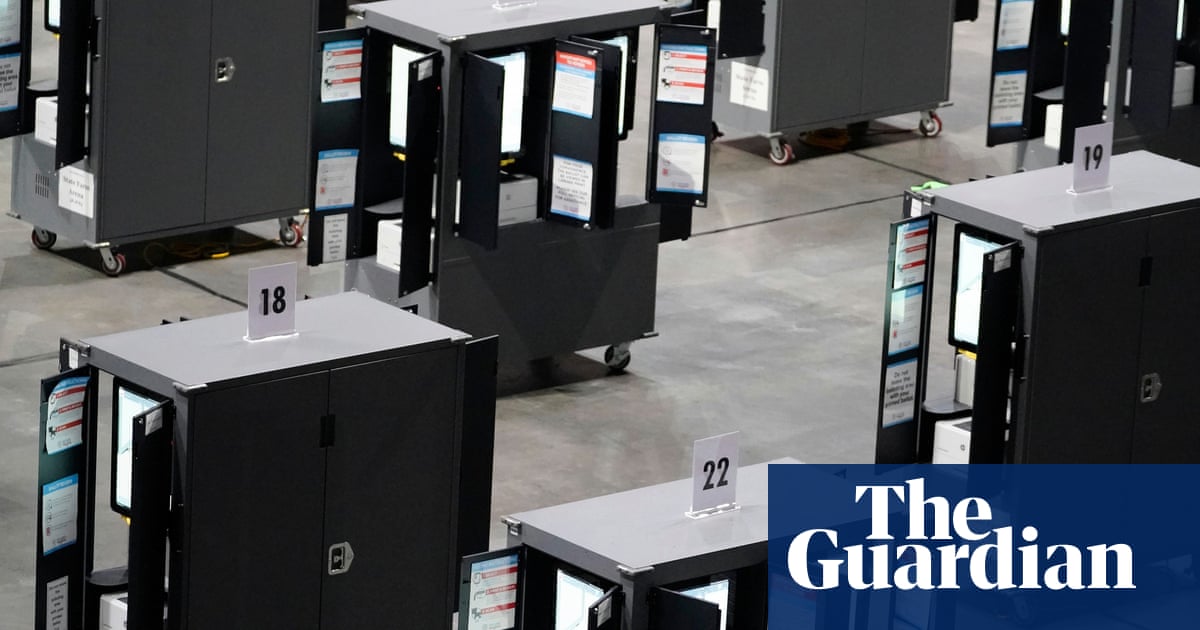
Election officials carefully document each voter entering polling places. Voters select candidates using a touchscreen, which then prints out a paper ballot that the voter feeds into a scanner for tabulation. “When a ballot is cast, a digital record is generated—similar to a row in a spreadsheet, referred to as a cast vote record (CVR),” Adida explained. Each CVR receives a unique identifier assigned during scanning.
The crux of the vulnerability lies in how these ballots are recorded; the identifiers are not sufficiently randomized, according to Adida. By utilizing AI, along with early voting lists and county cast vote record files, Springer—who has never set foot in Georgia—managed to reconstruct voting sequences for over 1.5 million ballots, or 98.9% of in-person votes in 114 out of 139 counties examined.
“In some counties, I can ascertain the precise ballots cast by each voter at vote centers, effectively nullifying ballot secrecy,” Springer stated.
In smaller counties with fewer voters, such as Heard County, Springer observed that the AI could match a significant number of early in-person voters to specific ballots, connecting most to just a single swap.
Approximately four years prior, election security researchers uncovered similar issues with the software used in Georgia’s voting process, which could link voters to their ballots. The assignment of unique identifiers to ballots stems from political apprehensions regarding election integrity, addressing fears of ballot tampering. However, the risk remains if information like voter check-in data is combined with other data sources, such as camera footage, creating the potential to deduce a voter’s identity.
Officials from the secretary of state’s office have stated that they have been voicing concerns about these vulnerabilities for three years, only to be met with resistance as funding proposals were entangled in ongoing political disputes between Raffensperger and conservative legislators aligned with Donald Trump, particularly following the 2020 elections.
Spokesman Robert Sinners shared numerous emails and records demonstrating requests for financial allocations aimed at upgrading the state’s voting systems, which fell on deaf ears. “We have submitted multiple comprehensive plans to the legislature—not mere patchwork fixes, but an entire overhaul to address known vulnerabilities,” Sinners remarked, lamenting the lack of funding from the legislature.
In contrast, other states utilize Dominion software for their elections and have either resolved similar software vulnerabilities or restrict access to sensitive election data.
Georgia’s laws establish conflicting priorities; while the state's constitution mandates secret ballots and has some of the strongest protections for ballot secrecy in the nation, recent legislative amendments spurred by election controversies have increased transparency expectations for election records.
Elections board member Salleigh Grubbs highlighted these tensions while proposing a measure requiring poll workers to hold ballots in a tray prior to submission, ensuring they are shuffled to obscure the order of printed ballots. Grubbs asserted that Raffensperger’s approach—redacting identifying numbers—could contravene existing laws.
However, some county election officials and board members, including conservative Republican Janelle King, voiced concerns about the practicality of Grubbs’ proposal. “We would be asking poll workers to completely retrain,” King expressed. “I worry about the security of ballots once they are deposited in a box and another individual is tasked with scanning them. What if something goes awry during the shuffling process?”
As the early voting period looms closer, Sinners pointed out that any process changes at this stage may be too late and come at a hefty price tag, echoing the urgent need for regulatory re-evaluation in the wake of AI advancements.