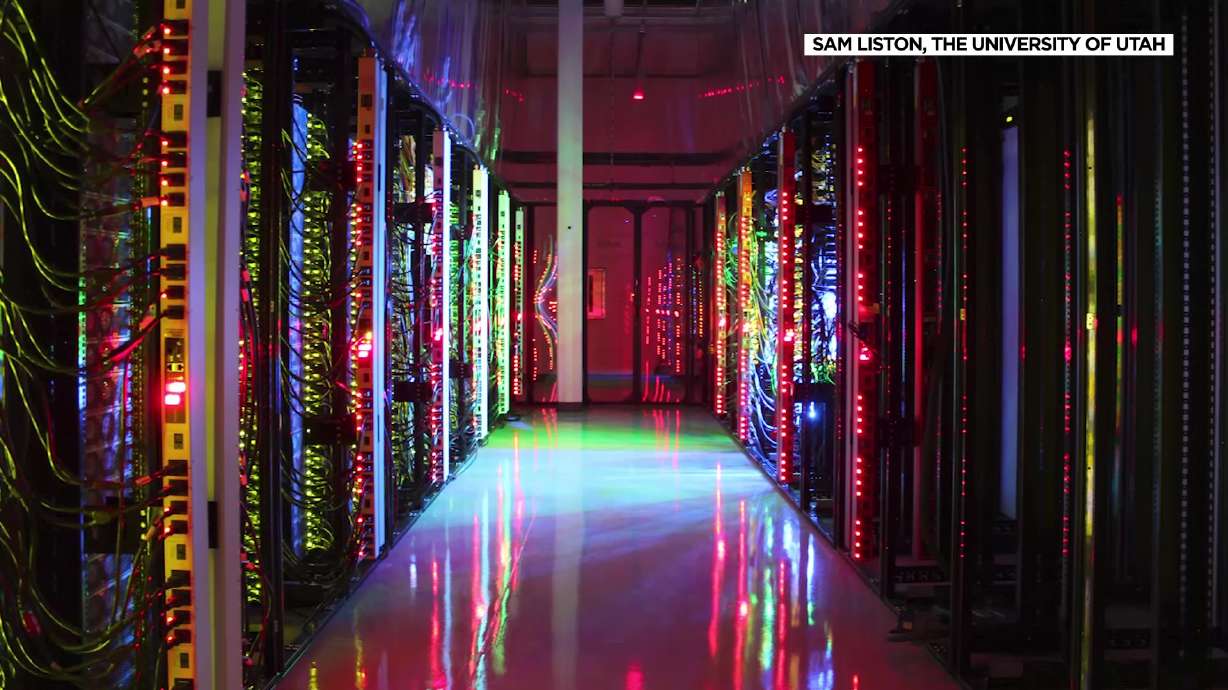
In Salt Lake City, the University of Utah has unveiled a groundbreaking supercomputer named Redtail, now recognized as one of the top 160 fastest supercomputers globally. Within its first month of operation, Redtail achieved an impressive 5th place among public universities in the U.S. on the Top500 list and secured the 76th position on the Green500, which ranks the most energy-efficient supercomputers.
This advanced computational system, which boasts a $50 million price tag, was financed through a collaborative effort involving the state of Utah, the Huntsman Family Foundation, Hewlett Packard Enterprise, and NVIDIA. It aims to provide vital computational resources for researchers, students, and businesses throughout Utah, facilitating the kind of AI-driven projects that require substantial processing power.
Manish Parashar, the university's inaugural chief AI officer, expressed enthusiasm about the potential of this new technology. “It shows that our state, faculty, students, researchers, and entrepreneurs have access to world-class technology,” he remarked, emphasizing the competitive edge it provides.
The initial interest in Redtail is significant, with researchers already applying its capabilities to diverse projects like climate modeling, air quality improvement, drug discovery, aerospace engineering, and notably, creating digital replicas of human vascular systems aimed at enhancing precision medicine. “This project addresses how to craft a digital twin of a human vascular system for more customized and effective treatment,” Parashar explained.
Coinciding with Redtail's introduction, the University of Utah was invited to join a National Science Foundation network dedicated to AI-driven Cloud Laboratories. Parashar mentioned that the Cloud Lab seeks to automate research processes, allowing scientists to collaborate regardless of their physical locations. Redtail’s robust processing abilities will be instrumental in developing models and AI functionalities for such initiatives.
This investment aligns with a broader strategy in Utah, where efforts to strengthen AI capabilities have intensified over the past year. The state has launched a $100 million Pro-Human AI Initiative, focusing on AI applications for education, air quality, and wildfire management. Additionally, the establishment of an $18.6 million Health AI Vault is enhancing research into cancer and medical AI. Recently, the university was recognized as a national leader in AI, ranking among the top 5% of educational institutions for its AI-related efforts.
The financial investment landscape also reflects this growth. Local AI startup Jump raised $80 million earlier this year, while Databento attracted $97 million in its Series B funding. Zanskar, specializing in geothermal energy through AI, secured $115 million. Collectively, Utah's AI sector has seen an influx of hundreds of millions in venture capital in 2026.
Jump's founder, Parker Ence, credits local investors with significantly contributing to his company’s success. “The funding we received from regional firms like Sorenson and Pelion was crucial for our growth,” he shared. He also highlighted the talent capable of competing with coastal companies, asserting that his entire executive team is composed of Utah locals.
Additionally, the Silicon Slopes community has initiated Start School, a program for aspiring entrepreneurs emphasizing that modern AI tools enable solo founders to launch successful ventures without needing venture capital.
On the regulatory front, Utah is making strides in AI governance, distinguishing itself from other states still grappling with regulatory frameworks. Margaret Woolley Busse, the executive director of the Utah Department of Commerce and the architect of the Office of AI Policy, noted a surprising surge of interest in healthcare-related AI innovations. “Business innovators here are developing transformative AI solutions that could greatly enhance residents' lives,” she mentioned, pointing to the state's proactive regulatory approach.
Utah has enacted several AI-specific laws, including mandates for consumer awareness when interacting with AI in sensitive contexts, protections against unauthorized deepfakes, and inclusive policies for AI-generated content.
As for businesses navigating the AI landscape, Kavita Ganesan, founder of Opinosis Analytics, an AI consultancy in Salt Lake City, noted a shift in focus among companies. While enthusiasm for AI was high, discussions have evolved into more practical considerations on implementing the technology effectively. “Organizations are not struggling with access to supercomputers or regulatory frameworks,” she observed, emphasizing that many are still exploring foundational aspects, such as identifying suitable use cases for AI and integration into existing operations.
Despite the notable advancements, Parashar acknowledged that Utah's journey in AI is just beginning. “While our progress is commendable, we are still at an early stage,” he stated, urging a forward-looking approach to prepare for future developments in AI.
The University of Utah is set to host its annual One-U Responsible AI Initiative symposium on October 6, further underlining its commitment to responsible AI advancement and collaboration.