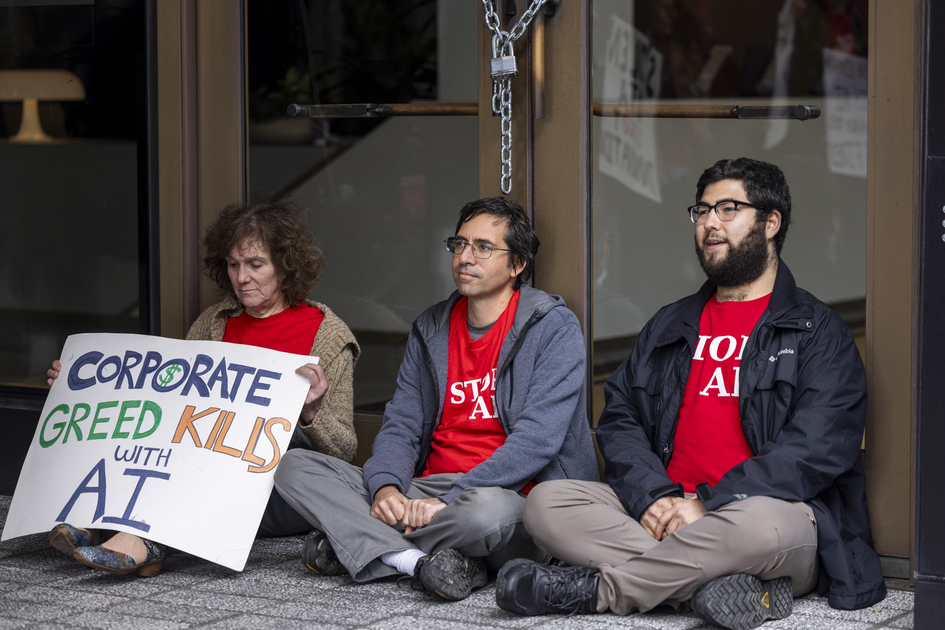
On the day before her scheduled surrender at San Francisco's Hall of Justice, Wynd Kaufmyn was bustling with activity. Taking the time to alter an old pair of jeans, she simultaneously engaged with reporters about her impending incarceration. In a gesture of camaraderie, she picked up coffee and doughnuts for her formal farewell at the courthouse the following morning. Celebrating her 69th birthday, Kaufmyn planned an evening out with friends at her favorite restaurant, Ben ‘N Nick’s in Oakland. A prominent figure in the protest organization StopAI, she is committed to halting the advance of artificial superintelligence. The group is known for its disruptive demonstrations, including chaining themselves to the doors of technology firms. Kaufmyn made headlines in February 2025 when she and four fellow activists were arrested for blocking the entrance to OpenAI’s office. As noted by StopAI, Kaufmyn has now become the first individual convicted and sentenced to jail for protesting, which they view as a crucial battle against the race to develop artificial general intelligence.
While the prospect of time in jail doesn’t excite her—Kaufmyn anticipates subpar food—she shared in a Thursday interview that she has no regrets about her actions. “The trial provided a platform for our message, allowing me to declare my innocence,” she stated. She firmly believes that the real threat to public safety lies with tech executives pushing boundaries, not with activists like herself. “Once the public realizes that, they’ll understand I’m not the one who deserves to be imprisoned.”
Kaufmyn's history with protests is extensive; she has lost track of how many times she has been arrested. Originally from Detroit, she moved to Berkeley for graduate studies in 1979 and became active in various social justice movements that used civil disobedience as a tactic. While working as an engineering professor at San Francisco City College, she protested the development of nuclear weapons and U.S. support for the Nicaraguan Contras, leading to arrests. Moreover, she was banned from entering Israel for a decade due to her advocacy for Palestinian rights. Although Kaufmyn is now retired and lives in a communal home, she occasionally works at a local thrift store. Her involvement with StopAI began when she crossed paths with two members at an anti-war protest last year, and their arguments about the potential dangers of artificial intelligence resonated with her. This led to her participation in the pivotal protest last February, where she took a seat by those blocking OpenAI's doors, humorously noting, “I thought they needed a bit more diversity.” The protesters went as far as chaining the entrance shut, prompting a call to police and their subsequent arrest.
While StopAI typically operates under the radar, their trial garnered attention for two significant reasons. Firstly, a public defender attempted to deliver a subpoena to OpenAI CEO Sam Altman during a live event, a moment that went viral online, although Altman ultimately did not testify. Secondly, the group’s leader, Sam Kirchner, vanished just before their initial court appearance, expressing doubts about the efficacy of nonviolent protest to another member. Concerned for Kirchner’s safety, group members contacted the authorities, resulting in a police search and a lockdown at OpenAI. He has not been located since.
The situation, along with violent incidents directed at Altman earlier this year, has raised alarms regarding the potential for activists to overstep boundaries in their fight against AI development. Although StopAI emphasizes its commitment to nonviolence and expelled Kirchner following his disappearance, critics assert that the group’s charged language has fostered a hostile atmosphere for those in the AI sector. An OpenAI representative remarked to the Wall Street Journal that “violent rhetoric and actions increase risks and hinder the necessary discussions at this critical moment.” Kaufmyn disclosed that the months following Kirchner's disappearance have prompted introspection within StopAI, leading to several members departing and the group refraining from protests since May, apart from a participation in the “Freeze AI on Slushy Day” march held in July.
As her legal proceedings unfolded, three of Kaufmyn’s co-defendants opted for judicial diversions instead of going to trial. One individual, Guido Reichstadter, had his case separated from Kaufmyn's after a missed court date linked to a protest in D.C.
Kaufmyn chose to stand firm, refusing any diversion or plea deal, and instead sought to employ the necessity defense—a rare legal argument asserting that illegal actions were essential to avert greater harm. In her case, the threat was framed as rogue AI, with humanity at stake. Expert testimony from UC Berkeley AI professor Stuart Russell compared the rapid AI advancement to a Titanic-style disaster barreling toward an iceberg. Ultimately, the jury found her guilty on multiple charges, leading to a judge's decision to impose a 14-day jail sentence in June. Nonetheless, Kaufmyn remains steadfast in her mission. “You aren’t fighting for a win; you fight because it’s necessary. Justice compels it, my conscience demands it,” she expressed. Her underlying motivation is clear: she believes that unchecked tech billionaires are constructing a dystopian society that threatens public safety, and this reality must be exposed.