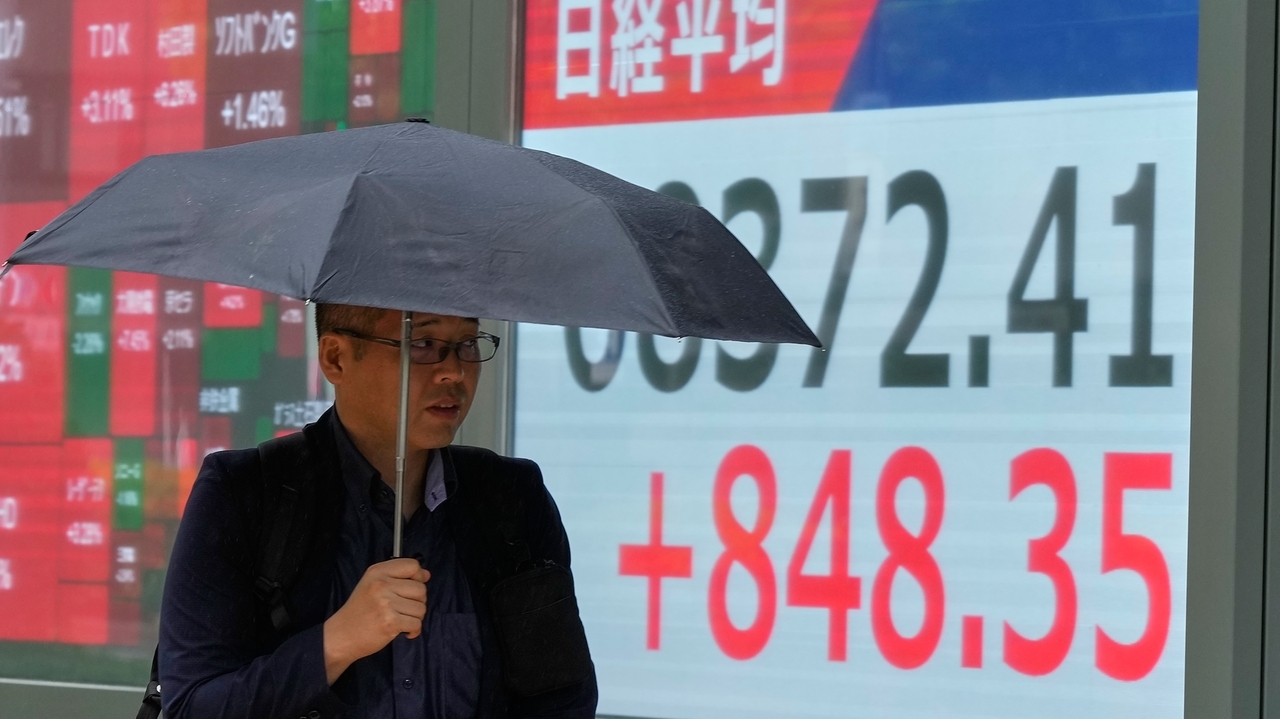
In early Thursday sessions, Asian markets experienced a predominantly positive trend as global optimism surrounding artificial intelligence (AI) stocks and the semiconductor industry fueled investor confidence.
Japan's Nikkei 225 saw a significant increase, climbing 1.6% to reach 68,609.92 points. In contrast, Australia's S&P/ASX 200 fell by 0.6%, landing at 9,155.80. South Korea's Kospi demonstrated a remarkable upswing, surging 3.9% to 6,835.55. Meanwhile, Hong Kong's Hang Seng index saw a minor gain of nearly 0.1% to 25,453.45, and the Shanghai Composite rose by 0.4% to settle at 3,961.82.
The upbeat sentiments across Asia were influenced by Wall Street's performance the previous evening, where major indices closed just shy of record highs. Several AI companies reported spring growth figures that exceeded analysts' forecasts, coupled with an inflation report indicating a slight improvement in the U.S. economy.
The S&P 500 index recorded a 0.3% increase, marking its first gain since reaching an all-time high on the preceding Friday. Conversely, the Dow Jones Industrial Average saw a slight dip of 21 points, while the Nasdaq composite advanced by 0.5%.
Leading the market rally were stocks in the AI technology sector, buoyed by strong earnings reports that heightened expectations for continued substantial growth, justifying the significant price increases they have experienced.
AI stocks are showing signs of a rebound after a tumultuous period characterized by volatility. After reaching record highs, these stocks faced mounting pressure as concerns arose regarding their rapid ascent. Investors were eager for large AI stakeholders to demonstrate that their expenditures were translating into meaningful profits and productivity, which could, in turn, sustain demand for essential components like semiconductors.
Additionally, Treasury yields declined as a report revealed that U.S. consumers faced a 3.4% year-over-year rise in living costs, including gasoline and groceries. This figure, while still undesirable, showed a slight easing from June's 3.5% inflation rate.
The slower inflation rate could provide the Federal Reserve with the flexibility to pause interest rate hikes. Fed officials remain divided on whether rate increases should have already commenced, but the latest inflation data influenced traders to reconsider expectations for a rate hike during the Fed's upcoming September meeting.
As a result, the yield on the benchmark 10-year Treasury bond fell from 4.70% to 4.68%, although it remains significantly above the 3.97% level recorded prior to geopolitical tensions, which had driven up oil prices and inflation fears.
In energy markets, benchmark U.S. crude experienced a decline of $1.07, reaching $82.20 a barrel, while Brent crude, the global standard, decreased by $1.01 to $87.97. Prices fluctuated mildly throughout Wednesday.
Overall, the S&P 500 climbed 20.30 points to 7,748.50. The Dow Jones Industrial Average dropped by 21.58 points, standing at 53,770.27, whereas the Nasdaq composite advanced by 143.04 points, reaching 26,588.49.
In currency exchanges, the U.S. dollar rose slightly to 159.43 Japanese yen, compared to 159.41 yen earlier. The euro was valued at $1.1525, reflecting a minor decrease from $1.1527.
The insights shared in this report were further supplemented by contributions from AP Business Writer Stan Choe.