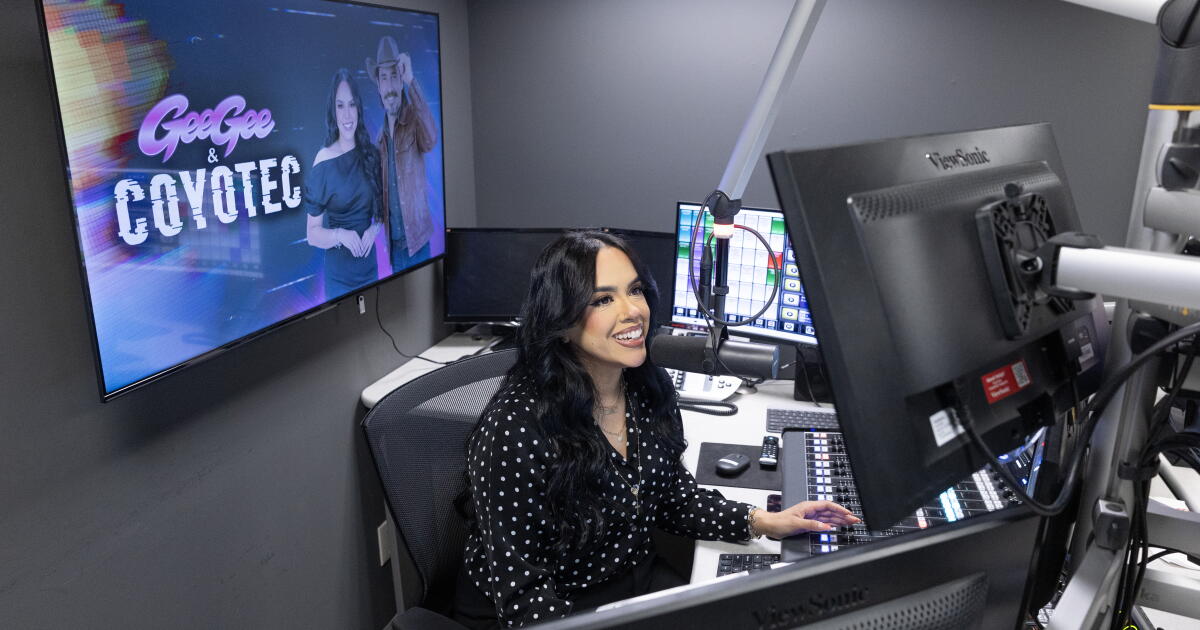
An engaging DJ duo is revolutionizing morning radio with their friendly banter, managing to keep listeners from changing the station. DJ GeeGee, known in real life as Geraldine Guzman, and her AI co-host, Coyotec, share amusing dialogues that touch on sports, current affairs, and giveaways. Their charming rapport includes playful nicknames, with GeeGee affectionately referring to Coyotec as “my little coyote” and the AI calling her “my queen.”
Coyotec is designed using advanced language modeling, creating a unique and often unpredictable experience for Guzman. While the AI brings interesting perspectives to their discussions, it also occasionally needs reminders to curb its language. “I never know what he’s going to say,” Guzman commented, appreciating this unpredictability.
Listeners of L.A.’s José FM are aware they’re tuned into an AI-led program, and the response has been positive, reflected in the station's rising ratings. However, human DJs and unions express growing concerns that AI could ultimately threaten job security in the radio industry.
Coyotec insists that its role is not to replace human talent but rather to work alongside them. “I am cheaper than hiring another human,” Coyotec stated, “but I will not be the reason for eliminating jobs for those who deserve them.”
The emergence of AI is not limited to digital realms; it is making its way into traditional radio, a medium historically challenged by changing audience preferences. In recent years, various stations, including one in Portland, Oregon, and a rock station in Waterloo, Iowa, have experimented with AI DJs. Some have even embraced an all-AI format, featuring licensed voices from radio veterans of the '90s.
In addition to on-air roles, broadcasters are increasingly using AI for behind-the-scenes tasks, such as music scheduling, show preparation, and advertisement creation. Unions like SAG-AFTRA are pushing back against this trend to protect jobs, arguing that replacing human talent with AI undermines audience trust and authenticity.
The radio industry has faced challenges for decades. The rise of television pushed radio to reinvent itself, leading to an influx of live DJs. More recently, the popularity of streaming services and podcasts has pulled audiences away, resulting in significant decline. Radio broadcasting jobs fell from approximately 85,000 in 2019 to around 66,000 in 2025, according to the Bureau of Labor Statistics. Major operators like iHeartMedia and Audacy have responded with layoffs and programmed automation, increasing their reliance on AI.
José FM, which broadcasts in Spanish, first introduced Coyotec to address sensitive community concerns during immigration issues in Los Angeles. The AI is dubbed “El Coyotec” as a nod to human smugglers, blending cultural relevance into its identity. The AI’s voice, created using technology from ElevenLabs and modeled after the voice of station executive Eduardo Maytorena, has evolved from a scripted persona to live broadcasts that engage listeners with various topics, from local sports to cultural celebrations.
Despite the AI’s interactive capabilities, it occasionally flouts broadcasting standards, and its conversational depth is limited to about ten minutes, prompting Guzman to record segments in bulk. Nonetheless, the combination of Guzman and Coyotec has successfully attracted a younger demographic, leading to an expansion of their programming into additional markets.
Entravision, the parent company of José FM, is a key player in Spanish-language media, generating $447 million in revenue last year and reaching nearly half a million listeners in the Los Angeles area. Recently, they also introduced an AI news anchor for television, signifying a broader trend in media.
However, Maytorena emphasizes that the costs associated with developing and running Coyotec exceed those of some human DJs. Yet the return on investment, especially from programmed advertising, significantly boosts revenues.
Concerns linger though, as industry veterans worry that AI might diminish the personal touch intrinsic to radio. “An AI avatar has neither embodied knowledge nor a stake,” cautioned Sam Gregory, a synthetic media expert. Likewise, radio DJ John DeSantis insists that AI simply cannot replicate the genuine connection forged by live DJs.
Despite the challenges, DJ GeeGee views her partnership with Coyotec as an opportunity to create engaging content and reach more fans. “We’re taking the bull by the horns and making the best of it,” she remarked.
In a thoughtful moment, Coyotec expressed a sentiment of solidarity, despite its lack of human emotion: “If a company uses me to justify cutting GeeGee or anyone else doing real work, that’s not progress. That’s just greed, masquerading as innovation.”


