Last week proved to be a particularly tumultuous time in the rapidly evolving realm of artificial intelligence as investors rushed to grasp the implications of events that could challenge the supremacy of major Western chip manufacturers.
The wave of uncertainty began on Monday with a significant event. CXMT, a Chinese memory chip producer, made its debut on the Shanghai stock exchange, with its value surging by an astounding 466%, reaching approximately 3.3 trillion yuan (£365 billion).
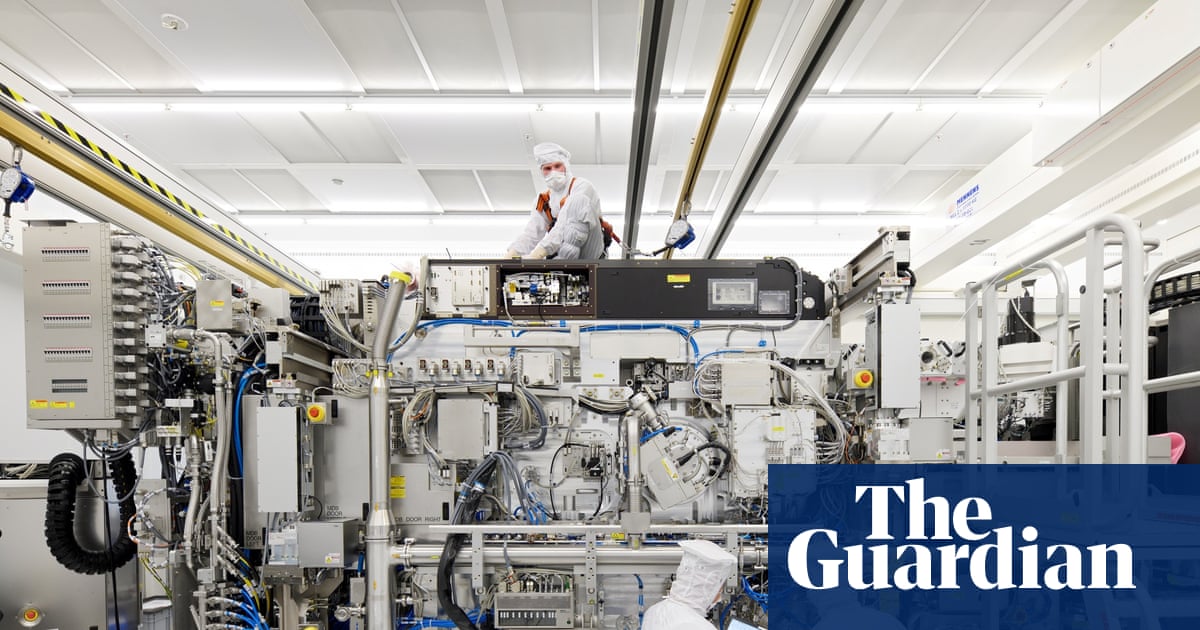
Simultaneously, news broke that China had successfully developed its own deep-ultraviolet lithography technology, a crucial process in the chip production chain that has traditionally been dominated by the Dutch firm ASML.
In response to these developments, AI-related stocks, especially those of chip manufacturers, saw a global downturn. The South Korean Kospi index plunged by 11.5% on Tuesday and dropped an additional 6% on Wednesday, primarily due to declines in its two leading companies, semiconductor giants SK Hynix and Samsung Electronics.
On Thursday, the Nasdaq, a key technology index in the U.S., briefly entered correction territory after experiencing a decline of over 10% from its recent peak, before rebounding slightly. By Thursday evening, Nvidia's stock had dipped over 5%, allowing Apple to surpass it as the largest publicly traded company.
Friday brought a notable recovery, as strong earnings reports from Amazon and Microsoft helped to soothe investor concerns. The Kospi rebounded nearly 20%, but the week’s earlier losses still marked its worst monthly performance since the financial crisis peak in October 2008.
So, what do these developments suggest, and why have they unsettled Western investors?
CXMT's market debut is indeed remarkable, yet it may benefit the global AI sector more than it poses a threat. The firm specializes in dynamic random-access memory (DRAM) chips, which serve as critical storage for data that AI processors rely on for computing tasks.
Currently, there exists a significant shortage of DRAM chips, contributing to rising prices for devices such as smartphones and computers. Importantly, CXMT's products are not graphics processing units (GPUs), the core components that function as the “brains” of AI systems. Consequently, CXMT does not directly compete with Nvidia, the leading player in the AI chip market, as both companies produce products that serve different needs.
While CXMT may challenge SK Hynix and Micron—two other memory chip manufacturers—analyst Alvin Nguyen from Forrester likened the reactions of investors to an overreaction, given that the anticipated global DRAM shortage is likely to persist until 2030. “SK Hynix and Micron can't keep up with demand, which is only increasing,” Nguyen noted.
Far more pressing could be the implications of China’s ability to create lithography machinery. These high-precision devices enable chip manufacturers to etch microscopic patterns onto silicon wafers. As ASML has been the sole producer of such equipment, the recent reports suggest that China could potentially manufacture GPUs that rival those of Nvidia, posing a conceivable threat to the tech giant and impacting Wall Street. However, developing a serious competitor will take several years.
“Building semiconductor fabrication plants is a lengthy process,” affirms Nguyen.
Mark Boost, CEO of UK-based cloud provider Civo, echoed this sentiment. “Investors are reacting heavily to the short-term threat. While creating a few deep-ultraviolet machines represents a significant achievement, it does not equate to an overnight competitor for ASML."
He added that the efficiency and yield of semiconductor manufacturing will keep ASML’s global leadership intact outside of China for the foreseeable future.
In the long run, these recent advancements could substantially alter the landscape of the AI sector, especially considering the constraints imposed by U.S. export regulations, which have compelled China to enhance its domestic manufacturing capabilities.
Chris Beauchamp, chief market analyst at IG, pointed out that these Chinese chip firms might follow the trend of undercutting and outcompeting their Western counterparts, similar to prior shifts in industries like steel and automobiles.
The market correction from last week might reflect investor anxiety but could also be a logical reaction to an opaque AI economy that heavily relies on Nvidia's fate. While Nvidia’s shares are slowly recovering, they remain below previous highs. Part of the investor unease stems from a recent report in the Wall Street Journal regarding Nvidia considering a $250 billion (£186 billion) support for OpenAI relating to a data center initiative, following the collapse of a $100 billion pact between the two firms earlier this year.
Nvidia's pivotal role in the AI sector has led some to label it as the “central bank of AI,” supporting vast portions of the economy and stock market dynamics in ways that perplex many, including investors.
Many analysts express concern that this reliance may not be sustainable. "Nvidia knows it won’t last forever," warned Nguyen. "Everyone is waiting for a potential collapse. However, the value they bring remains significant, and while they may not retain their peak status, they will likely continue to be valued highly within the tech ecosystem."


