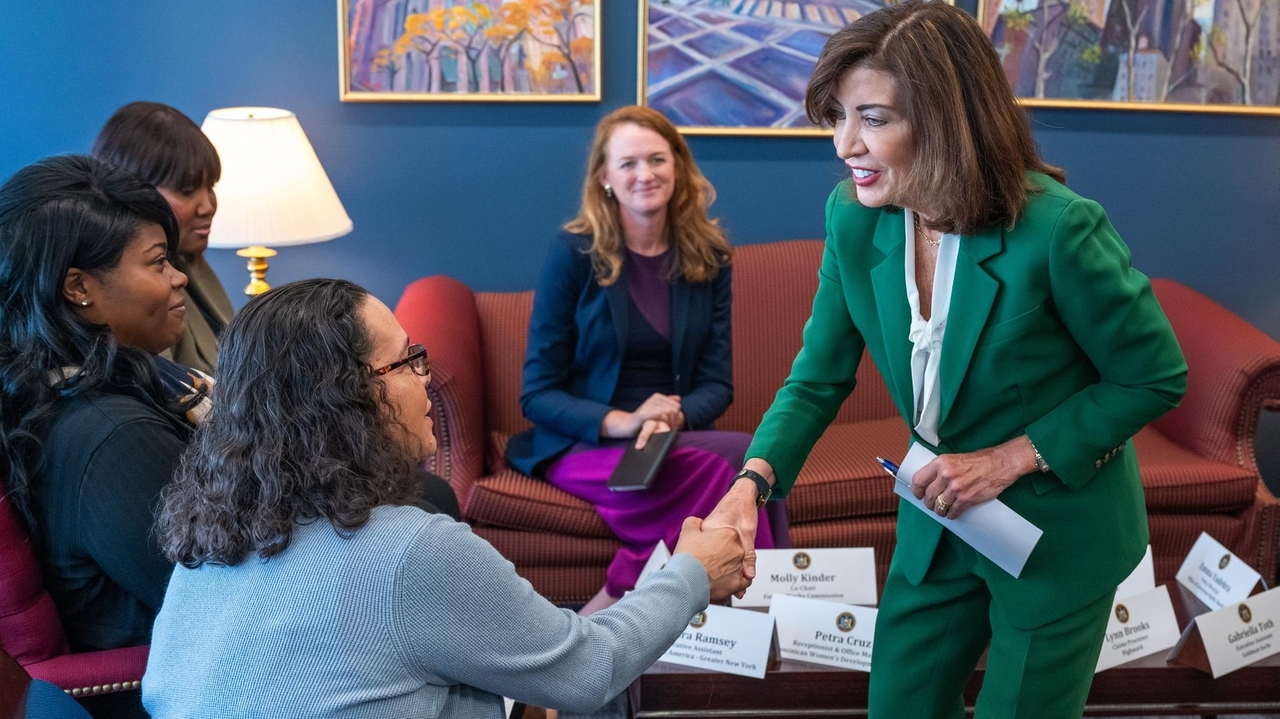
Governor Kathy Hochul highlighted significant concerns regarding the impact of artificial intelligence on administrative jobs predominantly occupied by women during a meeting on Wednesday. This gathering took place in her Manhattan office, where female professionals from across the state expressed their anxieties about companies leveraging AI for candidate screening and workforce reductions.
Current data from the state Labor Department indicates that around 169,000 individuals in Long Island hold office and administrative positions, which represent about 13% of local jobs. Projections suggest that job growth in these areas will be notably sluggish, with openings anticipated to rise by a mere 0.3% annually through 2032 in Long Island. Conversely, the statewide outlook is less optimistic, with an expected annual decline of 7,100 job openings in office and administrative roles through 2034, equating to a 0.6% decrease per year.
At the event, Hochul pointed out that women account for approximately 84% of these administrative positions statewide and could suffer disproportionately if AI continues to replace these roles. "I want to ensure that we in New York are equipped to handle this, especially for women in the labor force," she stated.
This upheaval driven by AI technology comes as New York makes strides in closing the gender pay gap. According to a recent analysis by the state Department of Labor, women's median full-time earnings reached 91.9% of men's median earnings in 2024, a notable improvement from a decade ago when women earned only 86.9% of what men made. However, these advancements are not evenly distributed, as disparities remain, particularly impacting Black and Hispanic women compared to white men.
Molly Kinder, co-chair of the governor’s FutureWorks Commission and a former researcher at Brookings Institution, remarked that office and administrative roles are among those most vulnerable to displacement from advanced AI technologies, like large language models. She emphasized the need for the state to brace for the substantial changes AI could bring to the job market. "While AI could potentially enable workers to engage in higher-value tasks, the risk of job displacement is stark, and that scenario demands close attention," Kinder explained.
She warned that such displacement might not resemble historic job losses seen in industries like manufacturing, as these positions may be phased out gradually, affecting workers one or two at a time. "It’s vital to recognize that these roles represent middle-class employment, and women in these jobs typically have less financial security," Kinder added.
During the discussion, Petra Cruz, an administrative assistant at the Dominican Women’s Development Center, voiced her belief that AI cannot substitute certain human interactions. "If a domestic violence victim enters my office distressed, a robot cannot provide the empathy or support that human interaction requires," Cruz remarked.
Governor Hochul's commission aims to produce recommendations by fall for incorporation into her upcoming State of the State proposals in January. She indicated that these strategies will focus on helping workers to adapt to AI in their roles or transition into sectors less likely to face AI-induced disruptions, such as healthcare. "We must navigate this challenge," Hochul concluded.