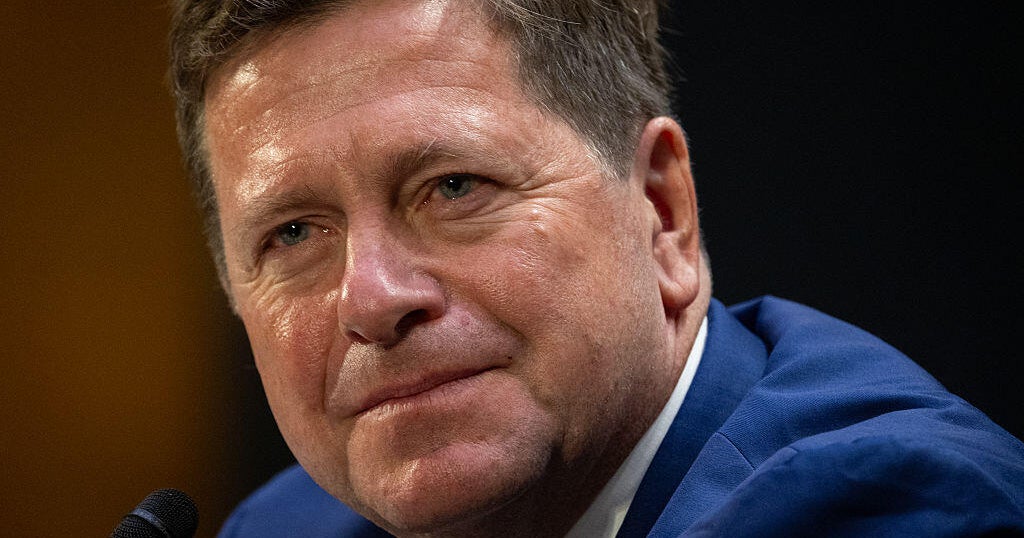
Jay Clayton is poised to be the White House's choice for the position of AI czar, while discussions are underway within the Trump administration about the possibility of him continuing as director of national intelligence, according to informed sources.
President Trump is anticipated to reach a final decision soon, as indicated by three sources.
Last month, Trump revealed his intention to appoint an AI czar through a social media post, stating, “Only High I.Q. individuals need apply!” This announcement comes as discussions intensify regarding the management of the risks and benefits associated with increasingly advanced AI technologies. Leaders from the nation’s premier AI companies convened at the White House on Tuesday to establish a set of voluntary safety guidelines.
Following that meeting, Trump informed reporters that he would announce the AI czar within three to four days, calling the prospective appointee "extraordinary."
In response to inquiries, a White House official stated to CBS News, “Any personnel announcement will come directly from the President. Until then, any reports are mere speculation.”
Clayton was confirmed as director of national intelligence in July. He is a lawyer by profession and previously held the position of top federal prosecutor in Manhattan, as well as leading the Securities and Exchange Commission during most of Trump’s first term.
Earlier in his second term, Trump had appointed David Sacks, a venture capitalist, as the cryptocurrency and AI czar. Sacks stepped down earlier this year but continues to serve as co-chair of the President’s Council of Advisors on Science and Technology.
In his potential new role, Clayton will engage in discussions among political and industry leaders about the regulation of AI technology.
Dario Amodei, CEO of Anthropic, and Sam Altman, CEO of OpenAI, both leaders of prominent AI companies, have expressed support for the concept of “pacing the frontier” in AI development to better address its associated risks. Some lawmakers are advocating for legal safeguards on AI. Conversely, key figures in the industry, including Sacks and Nvidia CEO Jensen Huang, have suggested that some of the dire predictions regarding AI’s threats to humanity are exaggerated.
Trump has voiced skepticism toward stricter AI regulations, emphasizing the economic advantages of the technology, which he refers to as “Super Intelligence,” and suggesting that a delay in progress could advantage Chinese AI developers. He believes that federal law enforcement is capable of addressing any misconduct.
During the White House summit on Tuesday, Trump and leaders of significant AI firms—including OpenAI, Anthropic, Google, Meta, Nvidia, and SpaceXAI—agreed on implementing multiple layers of internal controls and external audits to ensure their AI models function correctly.
Trump described this agreement as “morally binding” and “almost like a constitution,” stating, “I think I’m seeing tremendous self-policing, and they understand that they have to self-police.”


