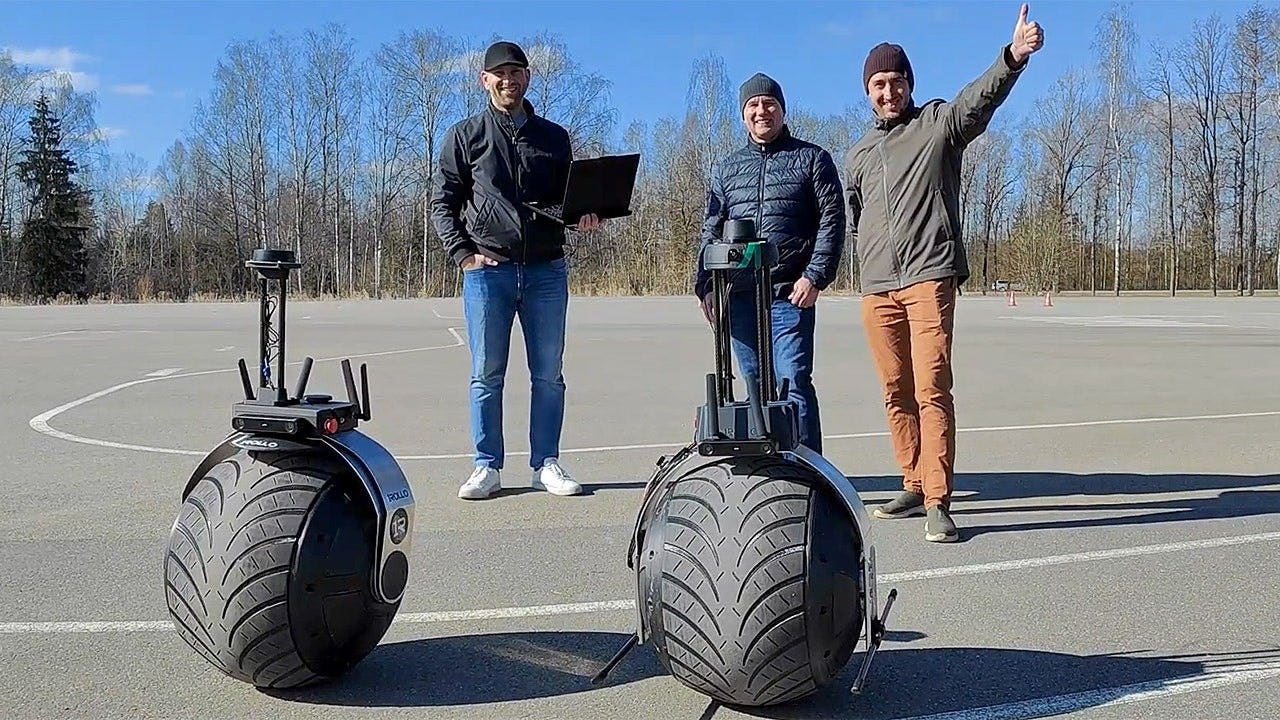
Imagine a futuristic security guard gliding through your workspace on a single wheel and never needing a coffee break. This concept is brought to life by the Estonian company Rollo Robotics with its innovative creation, the 1Rollo—a one-wheeled AI security robot designed for effective property surveillance. The startup claims that the robot's sleek profile allows it to monitor expansive areas at a fraction of the costs typical of conventional security vehicles.
1Rollo navigates pre-defined pathways while keeping an eye on its surroundings. If its onboard artificial intelligence picks up on any suspicious behavior, it can alert a human supervisor, who can then assess the situation and determine the need for additional security personnel.
Currently, 1Rollo is still in the prototype phase, with plans for a market-ready version slated for 2027. As such, design features and specifications may undergo revisions before launch.
The 1Rollo operates using a sophisticated 360-degree vision system paired with Real-Time Kinematic Global Navigation Satellite System (RTK GNSS) positioning, which enhances navigation accuracy far beyond traditional GPS. This technology enables the robot to adhere to its assigned routes while avoiding obstacles detected by its cameras and sensors. In the event of any irregularities in its environment, it can send alerts via Wi-Fi or mobile networks, including 4G and 5G.
Maintaining balance on a single wheel is an extraordinary feat for a 100-pound robot. Rollo Robotics achieves this with an internal spinning flywheel aligned with the wheel, providing stability. The robot utilizes this flywheel to tilt for turns, a mechanism that the company has filed for a patent. The design is compact enough to maneuver through areas where broader vehicles might struggle, although performance evaluations in challenging environments like stairs or uneven ground have yet to be published.
According to the company’s current specifications, 1Rollo stands about 43 inches tall, with a wheel diameter of 24 inches, allowing it to reach speeds of up to 19 miles per hour. It boasts a battery life of up to eight hours on a single charge and features autonomous wireless recharging capabilities.
The standard setup includes a 360-degree vision capability, but Rollo Robotics has intentionally designed the platform to support additional technology. Users could opt for thermal cameras for nighttime operations or pan-tilt-zoom cameras to monitor activities at greater distances. Other potential upgrades include night vision, RFID systems, and various custom payloads, providing flexibility for different security needs.
For managing multiple 1Rollo units, a cloud-based platform would enable operators to oversee and control several robots from a centralized location, facilitating route planning and performance assessment. The system allows operators to view live feeds and communicate via integrated microphones and speakers, offering a virtual presence without the need to dispatch a security guard immediately.
However, similar projects have faced scrutiny. For instance, an AI robot that was piloted in Dublin, Ohio, failed to make arrests within its operational period, raising questions about the efficacy of such automated systems. This example underscores the importance for potential users to set clear expectations and evaluation criteria for automated security technologies.
Rollo Robotics intends to introduce 1Rollo under a Robotics-as-a-Service model, allowing customers to subscribe for access instead of making an outright purchase. This would include up-to-date hardware, ongoing software enhancements, and technical support, potentially easing financial burdens associated with large initial investments and facilitating repairs and upgrades.
While the introduction of 1Rollo marks a significant advancement in security solutions, it also raises critical concerns surrounding privacy and cybersecurity. With its connected systems, the company must ensure robust encryption for camera feeds and operator accounts while maintaining transparency about data retention practices related to recordings. Additionally, it's essential for the robot to be programmed to function autonomously even during connectivity disruptions to ensure it continues to navigate and avoid hazards.
The emergence of 1Rollo signifies that businesses may soon see such robots patrolling their properties, particularly in expansive environments like warehouses and corporate campuses. While these machines have the potential to take over routine surveillance tasks, it's vital that employees and visitors are informed about how their privacy is managed, including details about data usage and retention.
In summary, while the unique design of 1Rollo presents a compelling case for advanced property monitoring, ongoing testing will be crucial to determining its performance across varied environments. Moreover, organizations need transparent information regarding pricing and operational effectiveness to make informed decisions about integrating this new technology into their security frameworks.
What are your thoughts on a one-wheeled AI security robot? Would it enhance your sense of safety, or would it raise privacy concerns? Share your opinions with us at CyberGuy.com.