When nursing students step into the emergency room, they transition from theoretical knowledge to real-world application. Similarly, when a therapist begins their first session with a client, there’s no opportunity for revisions. While healthcare students dedicate themselves to rigorous study, the true question remains: How effectively are they being prepared for the complexities of patient care?
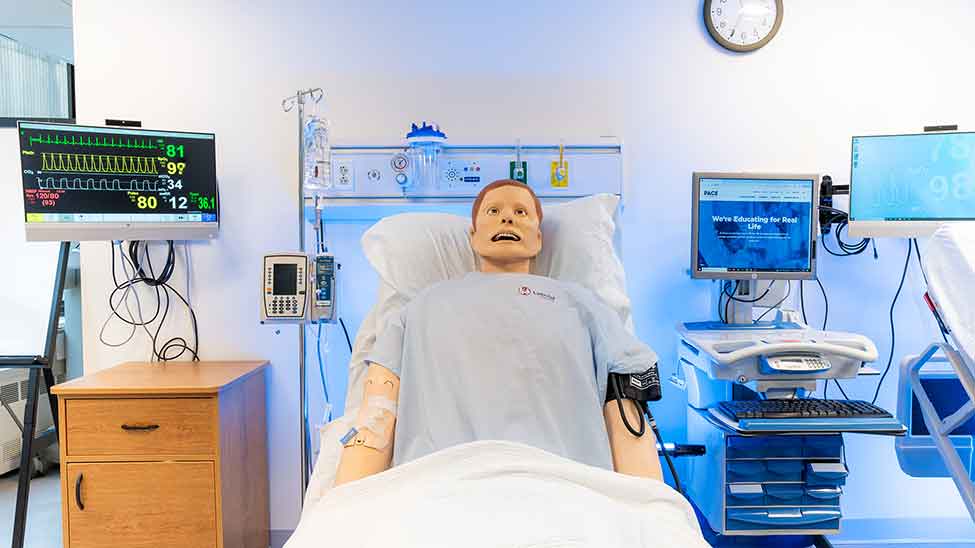
This is where Pace University’s Center for Excellence in Healthcare Simulation (CEHS) plays a crucial role. Often referred to as the simulation lab, CEHS was established by Patty Myers, who currently serves as the assistant dean of accreditation for the College of Health Professions. Located on both the New York City and Pleasantville campuses, the simulation lab allows students to engage with realistic clinical environments such as emergency departments, hospital wards, home care settings, and physician offices. This hands-on experience equips learners with essential skills while fostering a safe space for education.
The lab continues to adapt and innovate.
Recently, artificial intelligence (AI) has broadened the horizons of these simulations, fundamentally altering how healthcare students are trained to meet patient needs.
Nancy Owen, the CEHS director with extensive experience in simulation since 2015, emphasizes the lab's dynamic nature. Drawing from her background in nursing education, she notes the rapid advancements fueled by AI integration. “Simulation is really accelerating as we speak,” Owen remarks. “These AI-driven systems are groundbreaking technologies that have just emerged.”
With AI-enhanced simulations, educators can facilitate deeper learning experiences for their students. “Following established simulation protocols, instructors prep students, who then interact with AI avatars, followed by a reflective debrief,” Owen elaborates. “This process enriches learning… We explore what students did, identify areas for improvement, and highlight their discoveries. It’s not about replacing traditional methods—it's about enhancing our capacity to design clinical scenarios and assess competencies.”
During Fall 2025, students in the Psychiatric Mental Health Nurse Practitioner Program (PMHNP), guided by Laura Kelly, PhD, and Gabrielle Ranger-Murdock, PhD, were pioneers in utilizing this cutting-edge technology. AI's introduction allowed PMHNP faculty to develop progressive patient scenarios, enabling students to employ screening tools for concerns like anxiety, depression, and trauma, while also refining their consultation techniques. The PMHNP cohort engaged in a unique “clinic day” experience, conducting independent interviews with several patients—a feat unattainable with conventional simulation formats.
In the undergraduate nursing program, simulation educators Aimee Smith and Nancy Harrison crafted a pediatric case involving a nonverbal child. This AI interaction was designed for students to communicate with the child’s mother, adding a vital layer of guardian interaction. “The AI simulates dialogues that enhance students' communication skills, empathy, and ability to navigate challenging conversations,” Owen states. “We’re focusing not only on technical abilities but also on cognitive processing, compassion, and clinical judgment.”
Looking ahead, it's anticipated that the patient manikins at the College of Health Professions will receive AI upgrades. “Traditionally, simulation technologists have operated behind the scenes, voicing the manikins and responding during scenarios,” Owen explains. “Now, we have manikins equipped with AI that can engage learners in direct conversation.” This advancement promises exciting developments for the program.
The AI platforms are also capable of evaluating student performance using tailored rubrics that assess both diagnostic accuracy and empathetic communication. Faculty begin with established simulations—like scenarios involving diabetic patients—and modify them to meet specific educational objectives, allowing for personalized learning experiences while streamlining grading and fostering greater student engagement.
Owen reports positive feedback from both students and educators regarding the new AI simulations. Despite these advancements, challenges remain—she recalls an instance where an AI avatar repeatedly addressed everyone as “honey,” a humorous reminder of the careful pace at which these technologies are integrated. “There's a place for AI,” Owen affirms. “We’re exploring its optimal application and integration within our framework.”
As AI influences simulation strategies, maintaining a focus on human interactions remains vital. “One of the gems of our center is the standardized patient program, featuring live actors who engage with the students,” Owen mentions. “We’re accredited by the Association of Standardized Patient Educators, a distinction that sets us apart.” While AI facilitates scalable, customizable training, standardized patients provide the crucial subtleties of human interaction, preparing students for genuine clinical situations.
In an era where AI is increasingly prevalent across various sectors, adapting to these changes is essential for future readiness. For participants in the simulation lab, the future is already emerging. “Students must recognize how rapidly these changes are occurring,” Owen emphasizes. “Our mission at the College of Health Professions is to equip students for the realities they'll face once they graduate and enter clinical practice.”
At Pace’s Center for Excellence in Healthcare Simulation, this preparation is ongoing—one simulation at a time.