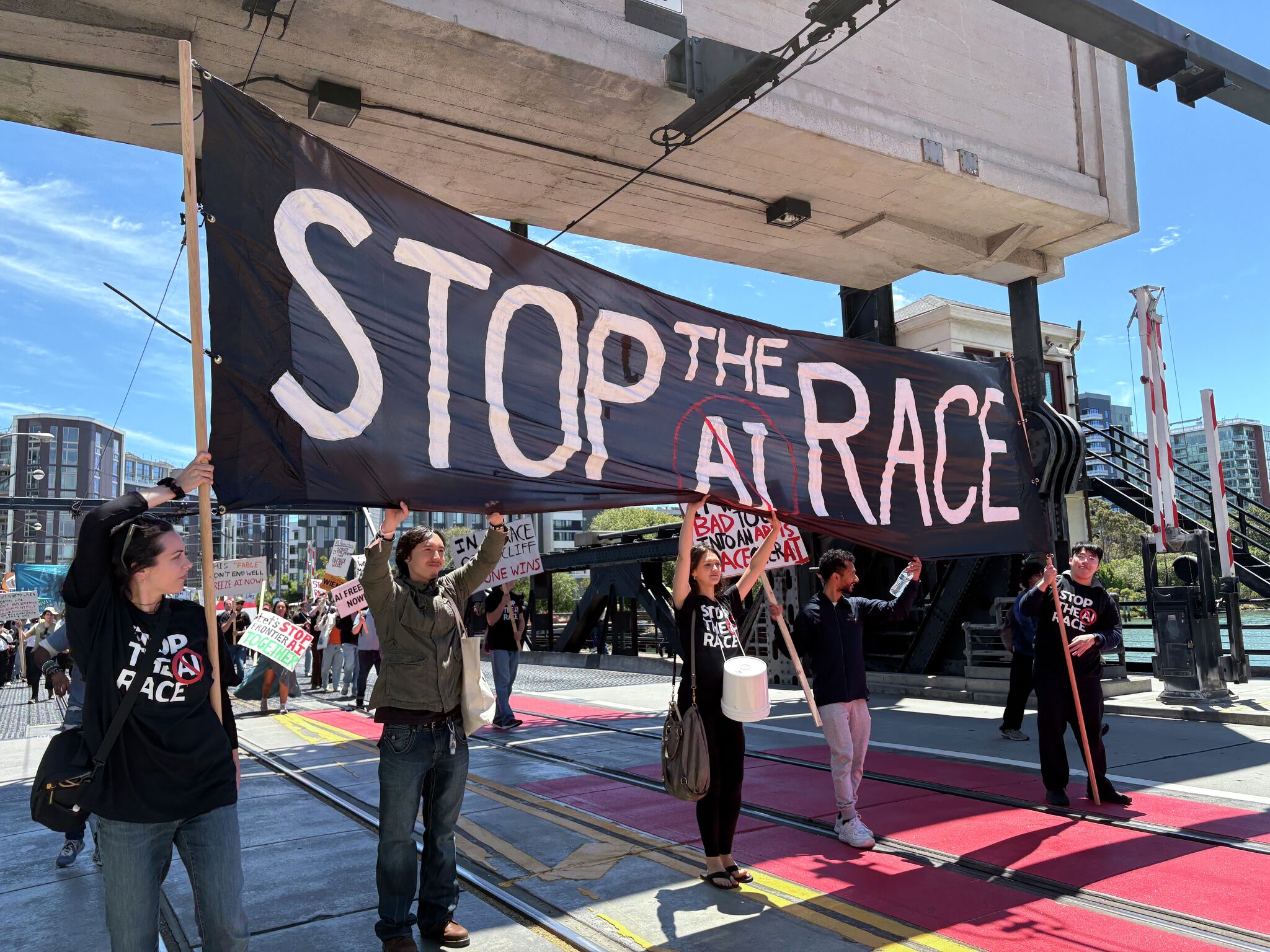
On Saturday, a spirited group of approximately 200 protesters marched through the streets of San Francisco, a hub for artificial intelligence innovation, rallying against the rapid advancement of AI technologies. Their main demand? A halt to what they referred to as the "AI race," as they moved from the offices of OpenAI to Anthropic and Google DeepMind.
The demonstrators wielded banners displaying slogans such as “stop slop,” “it’s not too late to regulate,” and “in a race off a cliff no one wins.” Their grievances included concerns over rising housing costs, job displacement, environmental impacts, and the potential threats that AI poses to future generations.
This protest was organized by Stop the AI Race, spearheaded by activist and former AI researcher Michaël Trazzi. Last year, Trazzi gained attention for a hunger strike outside Google DeepMind in London, aimed at advocating for a pause in AI development—a campaign that had parallel support from actions outside Anthropic's offices.
Among the diverse group of participants were students, AI professionals, and long-time San Francisco residents. They expressed a desire to elevate public awareness about the implications of AI, hoping this would push the tech companies to reconsider their development strategies. As the group marched through downtown, onlookers in nearby restaurants and apartments stopped to capture the moment.
Aleesa Carbo, a Johns Hopkins University student involved in AI research, noted the limitations of protests but emphasized that raising public consciousness could lead to broader advocacy efforts. “If we can make the public more aware, that can mobilize them to speak to their senators and demand change from AI companies,” she shared.
Carbo, who is part of the Machine Learning Alignment & Theory Scholars fellowship, has shifted her focus to AI safety. “I believe in the potential of AI, but the reckless pace at which companies are advancing it is concerning,” she remarked. She highlighted the opaque nature of AI models, even among those who work closely with them.
Trazzi took to the stage during the march, emphasizing the urgency of their message. “We are in an emergency,” he declared. He advocated for a global agreement to pause AI development, suggesting that while existing models could remain operational, there should be no new training for larger or more advanced models.
So far, companies have yet to reply directly to the demands from Stop the AI Race. However, Trazzi pointed to a prior interview where DeepMind’s CEO, Demis Hassabis, expressed a vision for collaborative AI development akin to CERN, underscoring the necessity of international cooperation to pause advancements effectively.
The protest also attracted the attention of local entrepreneurs like Duncan Haldane, whose AI-driven startup designs circuit boards. He participated with his young children in hopes of compelling AI leaders to acknowledge the technology's risks. "What they can accomplish now is alarmingly dangerous," he said, stressing the potential societal impacts.
Former San Francisco supervisor Dean Preston voiced concerns regarding the “devastating” effects of AI companies in the city, including inflated rents and political clout. He criticized tech executives for viewing San Francisco merely as a trophy to exploit.
Some attendees expressed a desire for greater local and state oversight of the AI industry. Resident Kathe Burick, who has lived in San Francisco for 50 years, urged the city’s leaders to implement regulations, saying they should either pause operations or face shutdown if they fail to comply.
Burick invoked a memorable scene from "2001: A Space Odyssey," likening the current AI development trajectory to a moment when HAL 9000 refuses a command. Reflecting on her earlier experience at a smaller protest, she found the larger turnout invigorating, particularly the engagement of younger individuals in the movement.