OpenAI's latest AI model, GPT-6 Astra, has achieved impressive results on the ARC-AGI-3 benchmark designed to assess agentic intelligence in abstract, turn-based environments. Utilizing two different harness configurations, Astra demonstrated an ability to effectively adapt to challenges and push the boundaries of current AI capabilities.
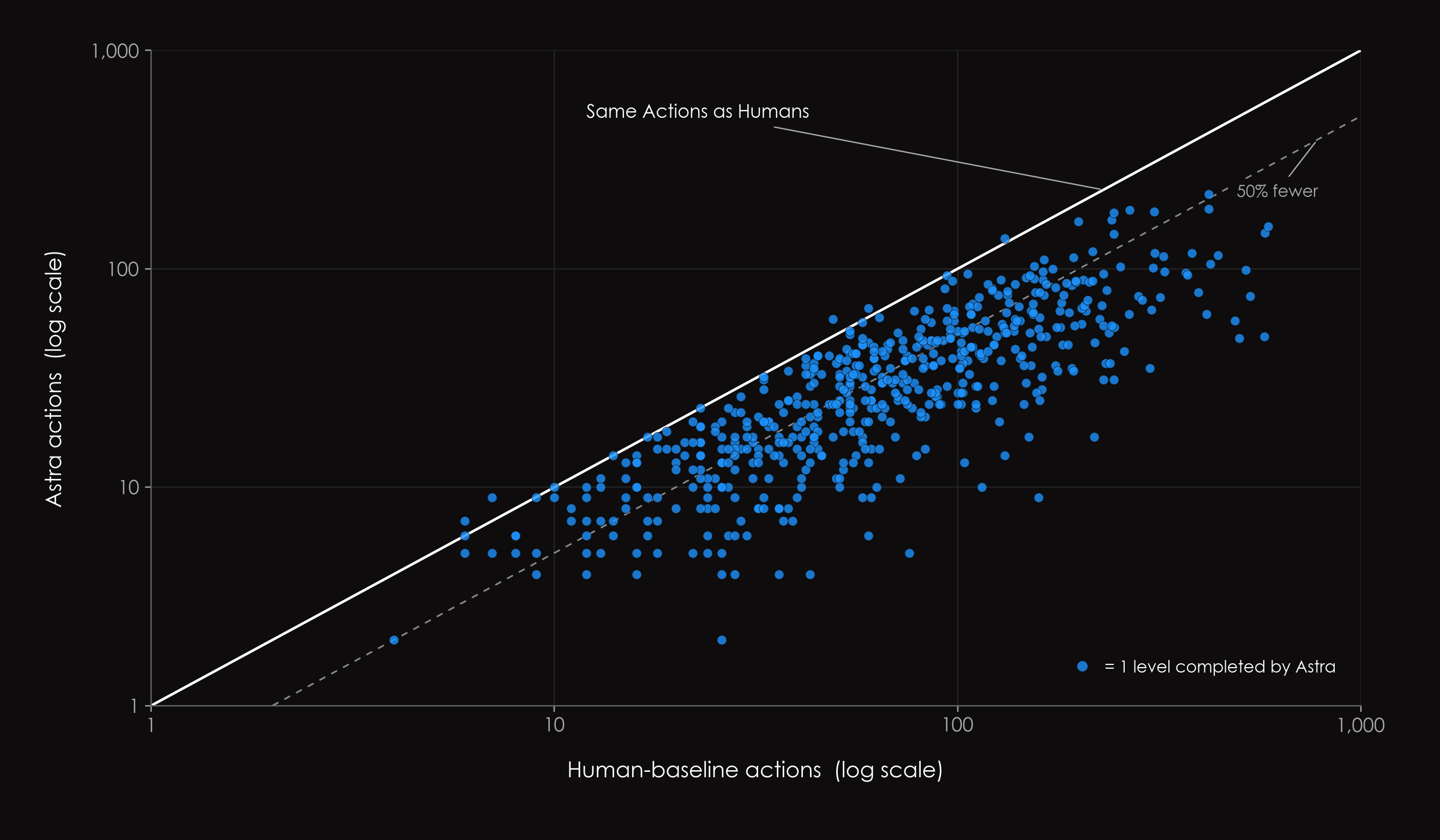
In its semi-private testing, GPT-6 Astra attained a score of 62.7% with a Standard harness priced at $26,000. Using the Provider Adapter harness, it scored an astonishing 99.9% for $19,000. This model not only surpassed human-level performance in terms of action efficiency but also executed tasks with fewer actions than 96% of tested humans across various levels.
A notable feature of Astra’s performance is its capability to transform unfamiliar gaming scenarios into compact symbolic models. It effectively articulated game mechanics using logical rules and devised its own shorthand for tracking game states and planning actions.
The ARC-AGI-3 benchmark, now in its third iteration, serves as a rigorous test of agentic intelligence, requiring models to explore environments, infer goals, and construct internal representations to navigate without explicit instructions. This series aims to highlight the remaining “residual gap” between present AI technology and artificial general intelligence (AGI), which is defined as a system capable of acquiring any human skill with equal efficiency.
To achieve this, ARC-AGI-3 evaluates four core components of agentic intelligence: exploration, modeling, goal-setting, and planning. Unlike its predecessors (ARC-AGI-1 and ARC-AGI-2), the latest benchmark incorporates increasingly complex challenges, aligning with the rapid evolution of AI capabilities.
The Standard harness allows Astra to carry forward relevant information while navigating its environment, which contributed to its 62.7% score. The Provider Adapter setup, which maintains reasoning states between requests and allows for more extended interactions, enabled Astra to nearly perfect its performance. The results reveal higher efficiency levels, as Astra required fewer actions to complete tasks, thereby reducing overall costs associated with its operational resources.
For context, human participants taking part in controlled testing sessions received $115 for 90 minutes of gameplay, plus bonuses for successful game completions. However, when considering the cognitive costs, the actual price in terms of the energy expended by the participants was comparatively minimal.
Further analysis highlighted Astra’s innovative approach to unfamiliar game mechanics. It developed a precise, compact algebraic notation for tracking objects, interactions, and strategies within the game, allowing for instantaneous modeling and planning. This level of reasoning and compact representation of information has not been seen as prominently in prior iterations of AI models.
In a comparative analysis, Astra’s efficiency was particularly notable. During the training phase, preliminary testing with 500 individuals established a human baseline for action efficiency. Astra produced fewer actions on 96% of tested levels, averaging 51.7% fewer actions than the human baseline, effectively indicating that it has not only matched but exceeded human performance benchmarks in this domain.
In addition to its performance on ARC-AGI-3, Astra was also evaluated in the more complex PRO-LONG harness, which allowed it to utilize custom code execution. Here, Astra invented specific tools tailored for each game it engaged with, streamlining its approach while interacting with the gaming environment.
These results from both the Standard and Provider Adapter harnesses present an opportunity for a clearer comparison of model performance across different contexts. Future assessments will continue to delineate between them, facilitating an understanding of how models perform under minimal interfaces versus when they utilize advanced provider-specific features.
While Astra’s achievements on the ARC-AGI-3 benchmark are significant, OpenAI acknowledges that achieving a complete understanding of AGI remains an ongoing pursuit. The ARC-AGI series is actively evolving to address the complexities of AI advancement, considering new benchmarks that will push the limits of what is currently possible and explore innovative dimensions of AI research, including self-improvement and innovation in open-ended scenarios.
Overall, GPT-6 Astra represents a substantial step forward in AI development, illustrating how frontier models can navigate and excel in complex environments. As the field continues to evolve, further exploration of these capabilities will illuminate future research directions and the ongoing quest for AGI.