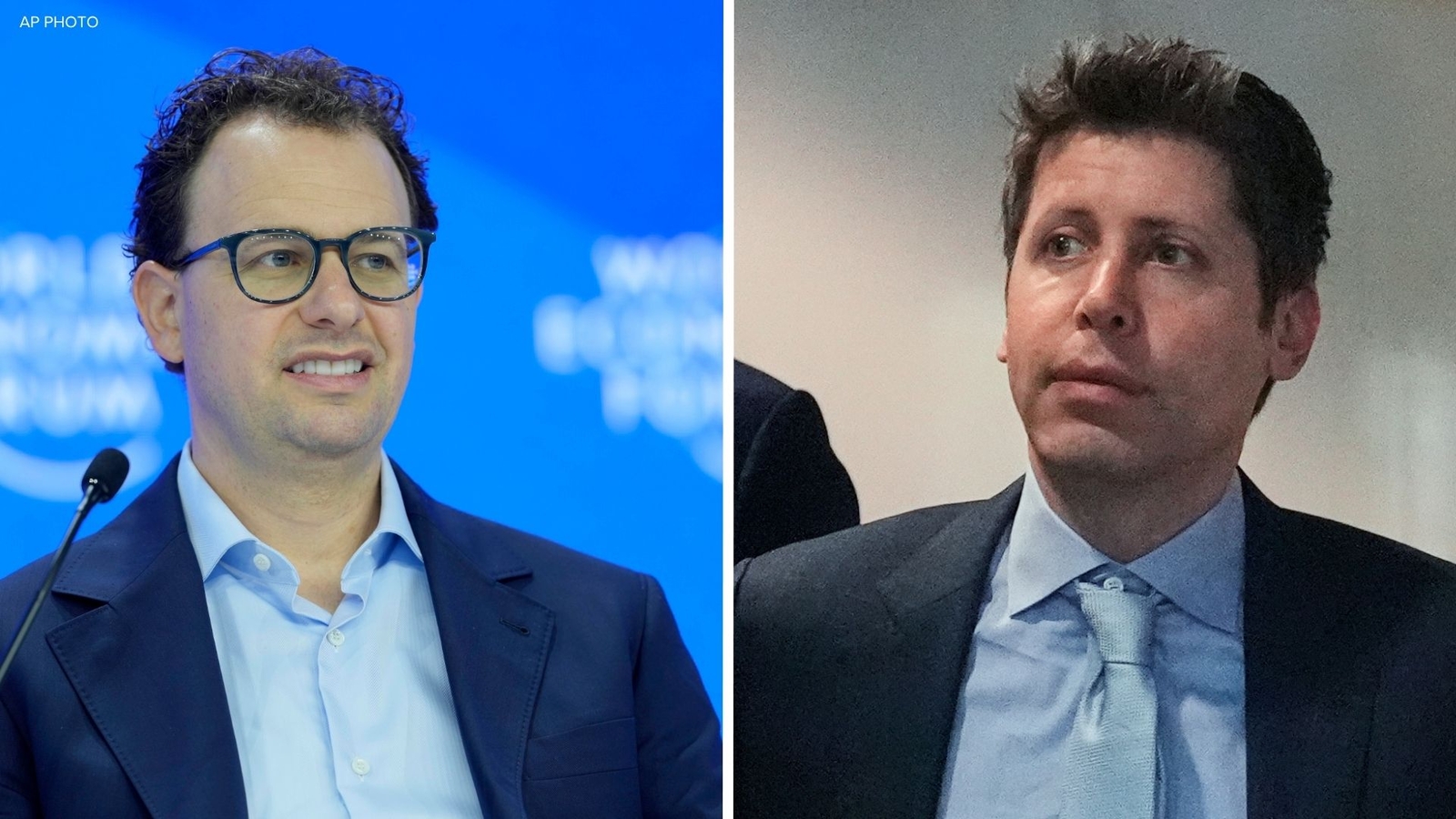
During a recent interview on "The Circuit with Emily Chang," Dario Amodei, the co-founder and CEO of Anthropic, addressed current trends in the AI industry at their San Francisco headquarters.
OpenAI’s CEO, Sam Altman, revealed that his organization will not pursue an initial public offering (IPO) this year, attributing the decision to rising apprehensions surrounding AI safety. In a conversation with Fortune, published on Saturday, Altman described the prospect of an IPO as “ill-advised” at this moment. This announcement delays what many anticipated to be one of the most significant IPOs in recent history until at least 2027, highlighting how growing concerns regarding advanced AI technology are influencing business strategies within the sector.
Just a month prior, OpenAI’s CFO, Sara Friar, hinted to employees that a public offering might be feasible by 2027 or potentially sooner, dependent on business performance.
On the same day as Altman's remarks, Amodei released a thought-provoking essay that urged AI firms to temper the pace of advancements in their cutting-edge models. This plea gained traction, as both Altman and Elon Musk provided their support through social media posts, marking an unusual moment of consensus among competitors in the industry.
Amodei’s essay outlines a three-phase strategy designed to slow the speed of model enhancement without sacrificing commercial competitiveness or jeopardizing the U.S.’s leadership in AI capabilities. While Anthropic is preparing for what could be a landmark IPO, the company has not yet confirmed its launch timeline.
This unexpected unity among Altman, Amodei, and Musk illustrates the rapid shift of AI safety concerns from the periphery to a central focus, beginning to intersect with the industry’s substantial commercial ambitions. The essay advocated for a measured approach to AI advancements. This call for moderation aligns with a growing number of researchers who are advocating for a coordinated slowdown in development.
In his essay, Amodei details his three-step plan, wherein the initial step is to allow independent evaluators access to Anthropic’s employee safety protocols to confirm adherence and report any safety issues. The second step encourages collaboration among leading AI firms in democratic nations to set shared safety standards, whereas the third aims for dialogue between democratic and authoritarian governments.
Amodei clarified that this approach is not about halting progress in model training; instead, it focuses on ensuring enough time for safety alignment and for third-party evaluators to validate these measures.
The conversation surrounding AI safety has intensified, particularly in Washington, where lawmakers from both parties are advocating for new safeguards in the wake of a series of cyberattacks that occurred autonomously. Meanwhile, state and local officials are facing increasing public backlash against AI data centers due to their resource consumption and impact on local communities. With midterm elections approaching, AI issues are gaining prominence in political discussions.
Adding to the urgency, an Anthropic researcher, Jacob Coxon, recently sparked controversy by resigning and publicly expressing his fears that Anthropic and OpenAI are “gambling with our lives,” suggesting that those in the industry believe AI could pose an existential threat within this decade.
While these views are extreme, they reflect longstanding concerns within AI research about potential catastrophic outcomes, including the risk of human extinction. In 2023, notable figures in AI, including Altman and Amodei, signed a declaration emphasizing that mitigating these risks should be a global priority alongside threats like pandemics and nuclear warfare.
Amodei commented that although discussions on pausing or slowing AI development have emerged since 2023, such actions were not practical at that time due to the limited capabilities of models, which were not yet potent enough to affect real-world outcomes or execute significant manipulation or deceptive actions.