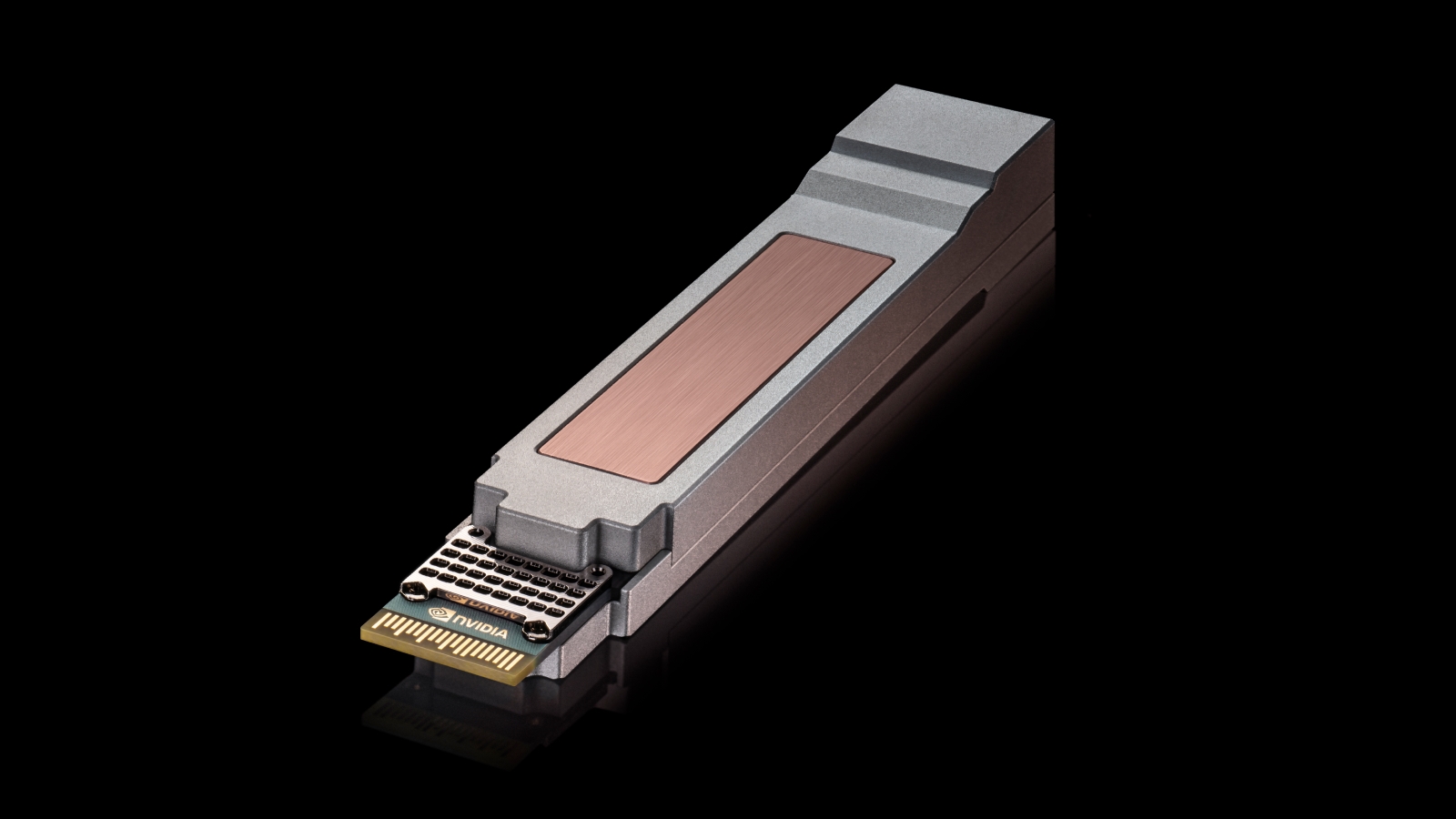
NVIDIA and Cisco have unveiled a groundbreaking initiative with the Ultra-Dense Small Form Factor Pluggable (USFP), a state-of-the-art 400Gb/s-per-lane optical module designed for next-generation AI factories. This innovative technology aims to enhance the hardware ecosystem for AI, allowing builders to expand their Ethernet AI fabrics while keeping an established deployment approach across various data center generations.
The USFP module offers remarkable improvements, delivering four times the bandwidth density and 1.3 times the power efficiency compared to existing 200Gb/s-per-lane optics. This advancement provides AI factories with the capability to connect a greater number of computing systems without introducing additional network layers, all while using less energy to transmit each bit of data.
As AI models advance and the demand for inference increases, there is an urgent need for AI factories to interconnect more computing resources while efficiently managing network complexities and costs. The USFP facilitates this by doubling the capacity from 200Gb/s to 400Gb/s per lane, ensuring operators can fully utilize their infrastructure investments and maintain streamlined operations.
The initial USFP transceivers will integrate 16 full-duplex lanes into an octal small form factor (OSFP) design, with future plans to extend to 32 lanes or more. This enhancement allows for the connection of additional 1.6Tb/s endpoints without the necessity for extra network layers, effectively increasing total capacity to a remarkable 12.8Tb/s.
Mirroring the size of existing OSFP modules, the USFP significantly boosts bandwidth while improving front-panel density and overall power efficiency, which enables AI builders to enhance computational capabilities within the same network footprint. Consequently, this reduces the proportion of power dedicated to networking within AI factories.
According to Gilad Shainer, NVIDIA's Senior Vice President, the initiative illustrates the importance of reevaluating even the smallest connections to build the world’s most extensive AI factories. He emphasizes that through USFP, NVIDIA and Cisco aim to revolutionize pluggable optics, linking more computational resources with enhanced efficiency designed for the next phase of AI factories.
Bill Gartner, Cisco's Senior Vice President, highlighted the need for an interconnect architecture that scales performance without complicating operational models. He noted that developing pluggable optics at 400Gb/s per lane goes beyond merely extending existing designs; the collaboration aims to enhance serviceability and operational simplicity while optimizing performance at each layer of the system, from silicon to network operating systems.
With USFP's capability to handle 400Gb/s electrical signals, it introduces a two-dimensional array connector that reduces wear and improves signal integrity, thereby making the installation process more reliable. This advanced connector allows room for future expansion to 32 full-duplex lanes, while it also optimizes performance even at lower speeds.
Additionally, the USFP can dissipate power up to 100 watts without requiring a dedicated cooling system, which simplifies switch design and enhances reliability, all while maintaining the operational maturity and serviceability of existing pluggable technologies. The optical designs under USFP promise reduced latency and power consumption, allowing system designers to cater to the specific deployment requirements of AI factories.
NVIDIA and Cisco are also collaborating with TE Connectivity and Amphenol to develop USFP modules, connectors, and cages, with more partners anticipated to join this effort. This unified form factor lays the groundwork for advancing high-density pluggable infrastructure within 400Gb/s-per-lane fabrics, which is essential for building a comprehensive ecosystem that supports AI factory builders.
This partnership builds on precedent work to ensure interoperability between NVIDIA Spectrum-X™ Ethernet networking and Cisco Silicon One-based Ethernet networks, simplifying the deployment of AI infrastructure across enterprises, neoclouds, and sovereign clouds.
Plans are in motion for NVIDIA and Cisco to establish an open industry specification for USFP, which will emerge through a future community-led multi-source initiative.