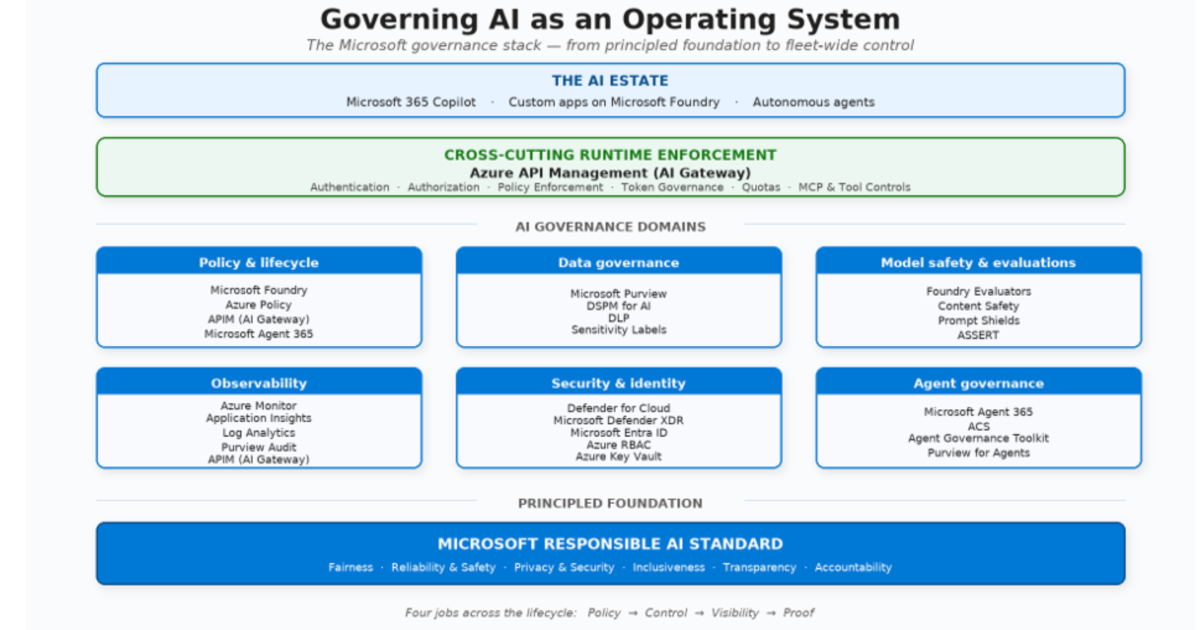
Microsoft has introduced a comprehensive framework for AI governance that shifts the focus from static policy documentation to dynamic enforcement mechanisms, continuous monitoring, and verifiable audit trails as organizations integrate AI applications and agents into their operations. This framework encompasses nine key governance areas and four primary functions: policy, control, visibility, and proof, emphasizing the importance of ensuring that governance requirements are actively applied and can be monitored in real time as AI systems are operationalized.
This architecture is designed as a feedback loop for governance. Initially, policies set the groundwork by defining requirements and classifying risks. These are translated into actionable runtime rules through controls, while observability mechanisms track system performance. Continuous evaluations assess both quality and safety, and audit processes convert this operational data into concrete evidence for compliance and retrospective incident analysis.
Manasa T. Ramalinga, a Cloud Solution Architect at Microsoft, elaborated on the inspiration behind this architecture in a LinkedIn post. She emphasized that organizations transitioning AI workloads to production are rethinking their core frameworks to create safer systems, rather than relegating governance to an afterthought.
Microsoft underscores the principle that effective scaling depends on the ability to govern successfully. The governance framework identifies nine distinct domains: policy, data governance, model governance, observability, evaluations, security, identity and access management, audit and compliance, and agent governance. This ensures that runtime controls can encompass all interactions involving users, agents, models, tools, APIs, MCP servers, and enterprise systems.
The governance architecture merges Microsoft Foundry with essential services like Microsoft Purview, Microsoft Entra ID, Defender, and Azure API Management. The AI Gateway within Foundry establishes a secure runtime boundary for tasks including authentication, token constraints, quotas, and policy enforcement. Additionally, Microsoft’s documentation details how this gateway manages MCP tools with centralized authentication, rate limiting, IP restrictions, and audit logging, all without altering MCP servers or agent software.
Evaluations are essential at both the pre-deployment stage and during ongoing operations. Microsoft Foundry provides support for assessing AI applications and agents against various datasets through built-in and customizable evaluators, allowing teams to ensure quality and safety before launch and monitor behavior afterward.
Anthony Bartolo, a Principal Cloud Advocate at Microsoft, highlighted this operational distinction in a LinkedIn post, claiming, "Your AI policy is not governance until production can prove it." He outlined the governance loop as starting from policies that define rules, followed by runtime controls that enforce them, observability that monitors behavior, evaluations that assess quality and safety, and audits that convert telemetry into evidence.
This governance model extends beyond a Microsoft-centric control plan. It integrates aspects of the NIST AI Risk Management Framework and Generative AI Profile, which offer a vendor-neutral strategy for managing AI risks throughout their lifecycle, including governance, measurement, evaluation, and risk reduction. Microsoft’s architecture effectively aligns these governance needs with specific platform controls and operational telemetry.
In addition to the general governance framework, agent governance introduces protocols governing agent identity, access, activity, and workflow checkpoints. Microsoft’s open-source Agent Governance Toolkit enhances the security of autonomous agents by providing capabilities for policy enforcement and establishing interception points. The architecture also includes an Agent Control Specification, which acts as a framework for implementing checkpoints across agent inputs, model calls, tool executions, and outputs, requiring human approval for more critical actions when necessary.


