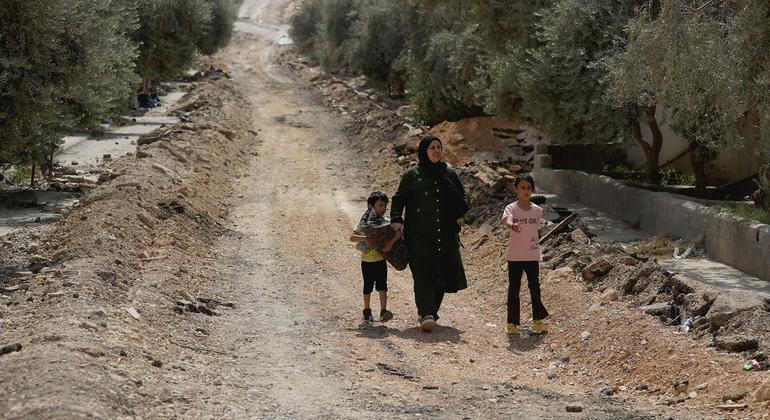
For over a year, six schools operated by the UN Relief and Works Agency (UNRWA) have been cut off from access, while another six have shut down entirely, reported UN Spokesperson Stéphane Dujarric to reporters in New York.
Dujarric noted that ten schools in Area C of the West Bank have been abandoned due to ongoing settler violence and access limitations.
On Wednesday, UN Deputy Humanitarian Coordinator for the Occupied Palestinian Territory, Suzanna Tkalec, spearheaded a joint humanitarian effort visiting a former UN school in Gaza, which is currently sheltering 18 families displaced by conflict.
Dujarric emphasized that the living conditions for these families have been severely compromised due to limited humanitarian aid access. He stated, "Our humanitarian partners are dedicated to mobilizing resources to meet the community's most pressing needs."
While the Israeli military continues its actions in Gaza and the West Bank, humanitarian workers are steadfast in their commitment to provide essential assistance. In the last month, UN partner organizations have distributed over 378,000 essential items—including tarps, cleaning supplies, and water containers—to civilians in Gaza.
In June alone, the UN World Food Programme (WFP) extended food vouchers and cash assistance to around 286,000 individuals in the West Bank. Nonetheless, the UN raised concerns about potential shortages of necessary supplies as winter approaches without increased financial support. Dujarric warned, "Without additional funding, our dwindling stockpiles can't be replenished, putting vulnerable families at heightened risk, especially with winter approaching."
The World Health Organization (WHO) highlighted the necessity of establishing health-focused regulations for artificial intelligence (AI) during a press release on Wednesday. It urged that AI governance must work to alleviate health disparities rather than exacerbate them. This alert coincided with a high-level conference in Lisbon, co-hosted by the WHO and the Government of Portugal, where representatives from 37 countries gathered to discuss responsible AI implementation in healthcare.
According to an April report by WHO, while 74% of EU Member States utilize AI for diagnostic assistance, only 11% have developed a health-specific AI strategy and a mere 8% possess liability standards for AI mishaps. Dr. Hans Kluge, the WHO's regional director for Europe, commented on the global struggle for responsible AI governance, emphasizing the need for healthcare systems to prioritize patient needs over those who can afford the technology.
Dr. Kluge pointed out the urgency of AI regulation, noting that patients increasingly rely on chatbots for medical queries. He stated, "Regulating AI in health is challenging, but failing to do so carries risks for patients, trust, and equality."
In 2021, WHO released guidance on the ethical use of AI in healthcare, stressing the importance of employing the technology safely and ethically to benefit patients and communities. The conference aims to develop strategies that ensure equitable access to healthcare technology for underserved populations as AI becomes more prevalent.
At the recent 19th session of the UN Expert Mechanism on the Rights of Indigenous Peoples, UN human rights chief Volker Türk remarked that the transition to clean energy should not infringe upon the rights of Indigenous Peoples. He pointed out that Indigenous rights defenders frequently encounter threats, violence, and legal challenges, especially when opposing development initiatives affecting their lands.
Between 2023 and 2025, it is estimated that 15% of human rights defenders who are killed or forcibly disappeared will be Indigenous individuals, Türk reported. He called attention to cases such as Brooklyn Rivera, an Indigenous leader from Nicaragua who passed away in state detention, urging Member States to uphold Indigenous rights.
Türk also celebrated recent victories, such as an Indigenous group in Australia that achieved unprecedented compensation for mining activities carried out without their consent. He affirmed, "Rights are not distant goals; they are immediate obligations. Where these rights are protected, society becomes fairer and more resilient."
He highlighted that Indigenous Peoples are often at the forefront of efforts concerning biodiversity, climate resilience, and resource management, noting, "Sustainable peace relies on justice, participation, and the recognition of rights." He called for acknowledgment of Indigenous Peoples' rights to self-determination and land control, emphasizing the historical injustices they have faced.
Türk urged countries to support the UN Voluntary Fund for Indigenous Peoples and the Global Alliance for Human Rights, which promote Indigenous involvement in international discussions. "By working together, we can place human rights at the core of decision-making everywhere," he said.