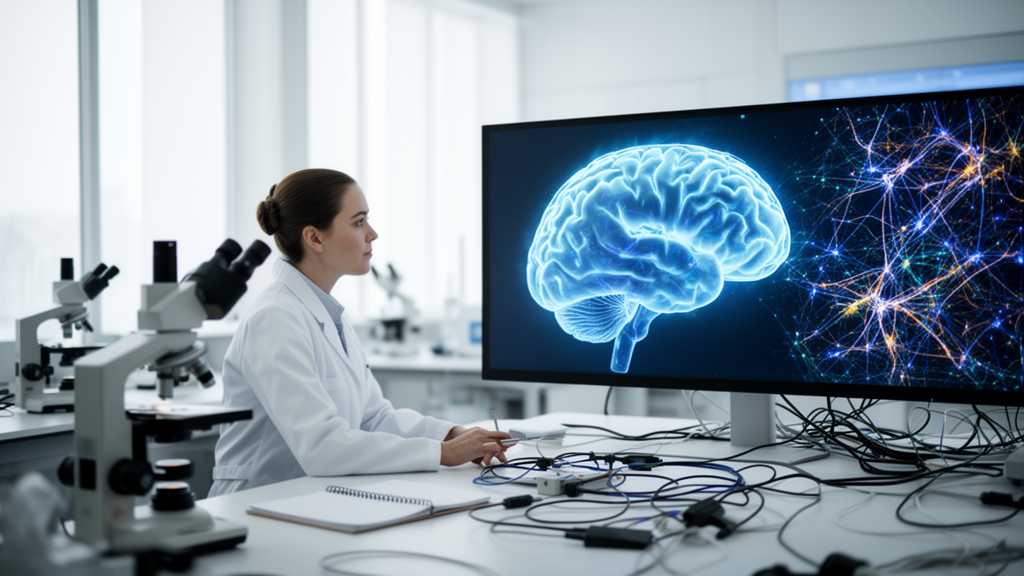
What distinguishes a chess engine capable of making exceptional moves from a human who comprehends the reasoning behind those moves? This intriguing inquiry, presented in a thought-provoking editorial in Frontiers in Systems Neuroscience, is framed not merely as a philosophical question, but as a pivotal barrier between advanced artificial intelligence (AI) and true artificial general intelligence (AGI). Authored by Yan Yufik from Virtual Structures Research, Robert Kozma of the University of Memphis, and James Kroger from New Mexico State University, this editorial wraps up a decade-spanning trilogy of research, asserting that the future of AI hinges on developing machine understanding, a depth of comprehension grounded in the self-organizing nature of biological neural networks.
The trilogy kicked off in 2016, focusing on self-organization within the nervous system, continued in 2021 with inquiries into cognitive capacities in humans and machines, and culminates with an analysis of the neurobiological roots of cognition. Throughout these installments, the editors pose fundamental yet complex questions: What constitutes intelligence? How is human intelligence distinct from that of other species? How could intelligence manifest in a purely physical universe? And what accounts for the extraordinary advancements in machine learning over the past decade, especially when these developments rely on ideas about digital neurons and perceptrons that originated in the mid-20th century?
The editors assert that a crucial distinction has been overlooked by much of the AI sector. While all species possess the ability to learn, the capacity for understanding is unique to humans. They adopt a definition from developmental psychologist Jean Piaget, describing intelligence as what an individual relies on when faced with an unfamiliar situation, when neither instinct nor prior experience provides guidance. In this context, navigating new circumstances requires simultaneously crafting an appropriate response and breaking free from previous learning constraints—a challenge current AI systems are unable to meet.
To substantiate their arguments, the editorial draws upon a century’s worth of psychological theories to create a unified technical perspective. Insights from Gestalt psychology contribute to the understanding that sensory information exists as distinct wholes before being labeled or utilized, a structural segregation that imbues the world with meaning. Piaget’s work provides a framework for conceptualizing understanding as an ongoing system of operational strategies transforming thoughts in a way analogous to physical actions. From William James comes the notion of attention persistently gravitating towards a desired object until the buildup of neural tension enables a breakthrough, while Donald Hebb’s ideas about neuronal assemblies suggest that interconnected groups of neurons serve as fundamental units of cognition, generating new percepts that rise above mere combinations of their individual components.
The editorial highlights a significant challenge: the combinatorial nature of meaning production, which is intrinsically tied to choice. The sheer number of possible selections from even a limited set of options can be staggering; for instance, just ten objects can yield 1,024 combinations, and considering their order amplifies this to an astounding 3,628,800. A chess scenario involving 32 pieces results in a mind-boggling array of possibilities. Nevertheless, the human brain adeptly navigates these complex landscapes in real-time with the power consumption akin to that of a low-watt light bulb. The proposed solution, known as the Virtual Associative Structures (VaST) concept, first introduced by Yufik in 1998, posits that understanding condenses these vast combinatorial options into smaller, more meaningful assemblages.
VaST is framed within a thermodynamic context, emphasizing that the brain, like any living system, seeks to maintain a steady energy flow from stimuli while minimizing caloric expenditures and losses. This goal is achieved through three mechanisms: neuronal packets that self-organize into associative networks, relational neurons that connect these packets across extensive stretches of stimuli, and coordinated complexes of packets that shape models functioning within hierarchical structures. When these models align with incoming stimuli, the complex combinatorial landscape reduces to a few relevant possibilities, allowing for meaningful interpretations. Notably, alternatives that are not pertinent do not get dismissed; they simply remain out of conscious awareness.
The authors of the editorial also draw connections to experimental research that underpins their abstract ideas. Studies demonstrating motor control indicate the attentive rotation of population vectors in the motor cortex, and neuroimaging of the frontopolar cortex suggests the existence of neurons specialized for recognizing relationships among structured components. Furthermore, research into packet-based communication within the cortex shows that neurons create organized bursts of activity, reinforcing the notion that packets are vital functional elements of cognition. The editorial references classic experiments on perceptual learning in monkeys which highlight the impact of focused attention on the sensory territory of representation; when a monkey actively focused on its finger being touched, the area of the cortex dedicated to that finger broadened significantly, while no such change occurred in a monkey distracted by other stimuli. This suggests that attention plays a crucial role in reconfiguring the energy landscape of experiential understanding.
Integrating these findings, the editors establish a cohesive framework that merges major theoretical constructs. The principles of VaST closely align with Karl Friston’s Active Inference Theory, which posits that brains strive to minimize variational free energy—the gap between expected and observed inputs. Moreover, it correlates with Yann LeCun’s Energy-Based Models, which aim to minimize an energy function that assesses compatibility between inputs and outputs, while also inferring latent variables. The editors propose that the latent variables observed in energy-based models reflect the latent relational variables suggested by VaST, creating a mutually reinforcing dynamic between these frameworks: improved alignment leads to reduced prediction errors and vice versa, all focused on optimizing energy flows and minimizing costs.
To clarify the distinctions between perception, learning, and understanding, the editorial returns to the example of chess. A chimpanzee reaching for fruit may coordinate its visual and motor activities, but lacks true understanding; it does not recognize that various stick lengths relate to different box heights. In contrast, a chess player tackling a checkmate scenario operates within a mental framework—a superposition of potential king-and-rook-versus-king configurations—that informs strategic moves. In this cognitive model, every potential move is interconnected, influencing the broader game strategy. Once developed, such a model integrates into an evolving repertoire, continually refining its identity while constraining possibilities in its constituent elements. The editors argue that merely testing AI systems through traditional Turing tests is akin to playing a game of peekaboo; the real challenge lies in unraveling the biological processes fostering genuine understanding and finding ways to replicate them in manageable procedures.
In conclusion, the editorial presents thought-provoking topics for future exploration, touching on concepts such as the Libet phenomenon, reinterpreted as the energetic cost of consciousness rather than a challenge to free will, and the potential connections between Piaget’s concepts of coordination and Roger Penrose’s quantum-entangled cellular structures. They also note that the etymology of the Latin word "cogitare," meaning to think, translates to "to shake together." This analogy suggests that propagating waves of activity throughout the cortex actively sort neural packets, akin to shaking mixed nuts, nudging the system towards optimal configurations. While the fate of specific hypotheses remains uncertain, the editorial's central message to the AI community is clear: deep learning enhances automated responses, but achieving systems that understand requires the development of self-organizing structures capable of generating meaning, operating on minimal energy, and possessing a degree of self-explanation.