Good morning! Today, we’re highlighting the innovative London-based company, Kraken Technology, renowned for creating "autonomous maritime platforms."
At first glance, it may sound like something out of a sci-fi movie, resembling a high-tech ghost ship. Founded by Mal Crease, who has a background in speedboat racing, Kraken Technology specializes in uncrewed underwater vehicles designed for military and security applications. They have partnered with the U.S. firm Anduril and have recently achieved a notable billion-dollar valuation.
“Look at me. Look at me,” warns the AI. “I’m the captain now.”
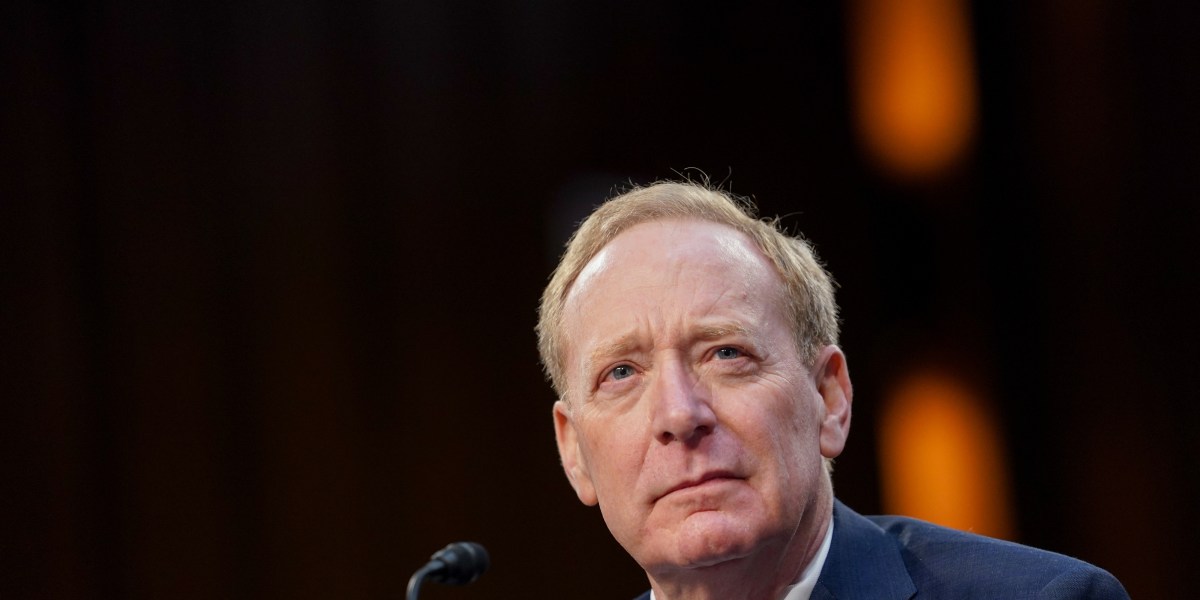
In other tech news, let's dive into the current landscape of AI policy in the United States. Microsoft President Brad Smith recently voiced concerns regarding the lack of transparency in the administration's AI policies during an interview with Fortune at the AI for Good Global Summit in Geneva, Switzerland. He noted that while there’s a reluctance among many to impose regulations, the reality is that current measures are akin to regulation without clear guidelines.
Smith highlighted a recent decision by the Trump administration, which sought to limit access to advanced AI models due to cybersecurity concerns. The Commerce Department mandated that Anthropic withdraw its Fable 5 and Mythos 5 models globally, while OpenAI faced pressure to delay the rollout of its new GPT-5.6 model family, restricting it to government-approved partners. Although these restrictions have since been relaxed, Smith argued that the government is attempting to regulate frontier AI using inadequate tools.
He stated, “The U.S. government acted correctly based on urgent cybersecurity threats they identified, but the method they used—the export controls—was not designed for the widespread AI models we’re seeing today.”
Legal experts have expressed skepticism about the effectiveness of these export controls, suggesting they may not withstand a legal challenge. Smith emphasized the necessity for a balanced approach to regulation, advocating for a more nuanced discussion moving forward.
In European politics, the battle against child sexual abuse material (CSAM) continues. While there is a consensus on the need to eliminate CSAM online, the means to achieve this remain contentious. Earlier this year, the European Parliament rejected a bill, dubbed "Chat Control," that would have permitted tech companies to scan for CSAM, fearing it could lead to unwarranted mass surveillance.
However, the Parliament has recently shifted its stance and voted to present the bill to EU member states for consideration, now with an exclusion for platforms that offer end-to-end encryption, such as WhatsApp and Signal. Support for this bill is mixed, with the center-right European People's Party backing it more strongly, while liberal and social-democratic groups remain divided. Should the European Council fail to reach an agreement, a seldom-used conciliation process will allow a temporary joint committee six weeks to develop a compromise.
As the debate continues, tech companies find themselves in a challenging position. Although they are attempting to scan for CSAM, the legal complexities surrounding the revived bill have left many questions unanswered.
In monetary policy developments, Federal Reserve Chair Kevin Warsh announced the formation of five task forces aimed at guiding the Fed's work on critical monetary issues, with several notable tech figures joining the discussions.
The task forces, addressing topics such as Fed communication strategy, balance sheet management, inflation, and job productivity, include a variety of experts. Of particular interest is the task force that will assess the economic effects of emerging technologies, including AI. Members include prominent investors like Marc Andreessen, who has ties to multiple AI-focused companies, and Xbox CEO Asha Sharma, who previously led Microsoft’s CoreAI division, alongside economist Charles I. Jones, who is studying AI’s economic implications at the Anthropic Institute.
With Warsh newly appointed by President Trump, it remains to be seen how his leadership will shape monetary policy, especially regarding interest rates, which have remained steady at the current rate following the Fed's June vote.
In other tech updates:
- Meta has launched Muse Spark 1.1, a robust upgrade to its multimodal AI model. - OpenAI's Sam Altman indicated that the company made several modifications to its AI models after discussions with U.S. officials. - Google plans to append a disclosure to all advertisements generated with its AI technology. - A global operation led by Interpol has resulted in the arrest of 5,811 suspects and the confiscation of $293 million to fight social engineering scams. - U.S. venture capital investment in the first half of 2026 has already surpassed the total for all of 2025 by 30%. - The startup Mercor has acquired Deeptune, which specializes in creating simulation environments for training AI agents. - India has eliminated import duties on certain phone components, effective through March 31, 2029.
Have a fantastic weekend, and stay tuned for more tech insights!