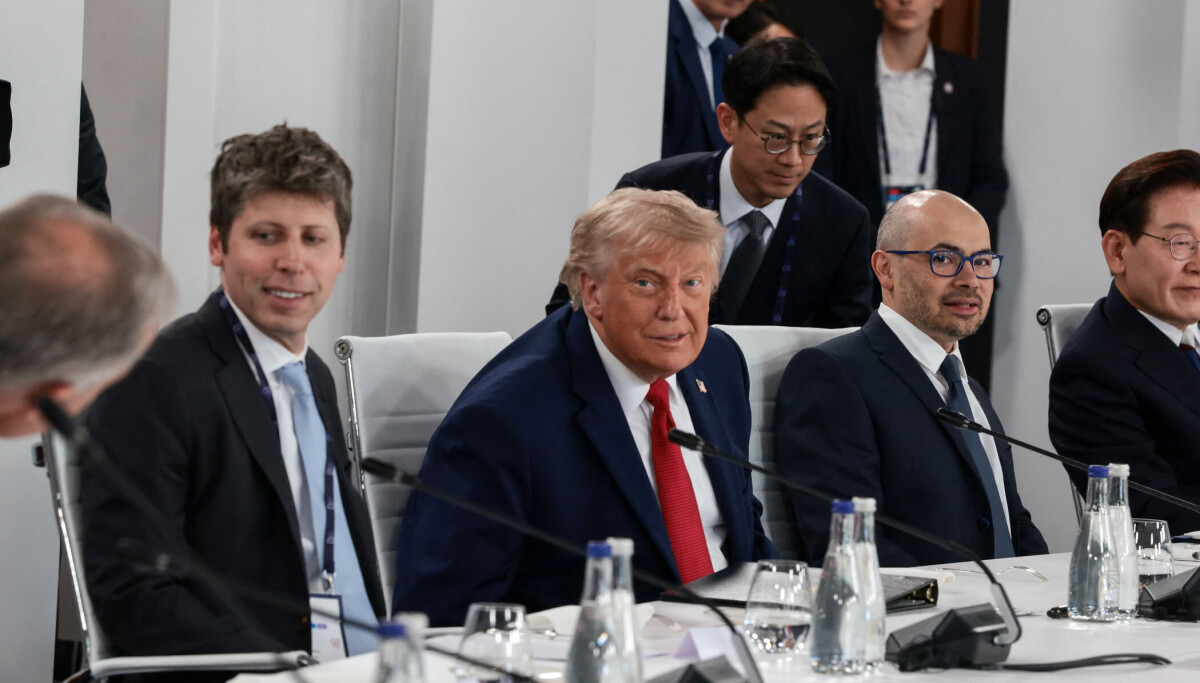
During a working session at the G7 summit in Évian-les-Bains, France, on June 17, influential figures including OpenAI CEO Sam Altman, former U.S. President Donald Trump, Google DeepMind CEO Demis Hassabis, and South Korean President Lee Jae Myung gathered to discuss fostering economic growth.
Demis Hassabis's journey in artificial intelligence underscores both the vast potential and pressing need for global regulations surrounding the technology. His remarkable background is notable; by age 13, he was already a chess master. After gaining experience in the video game industry, Hassabis pursued a degree in computer science at the University of Cambridge. He later returned to game design, where he faced a significant challenge: despite advancements in programming, game characters lacked the ability to act autonomously and intelligently. Realizing that understanding human intelligence was essential for developing genuine AI, he earned a Ph.D. in cognitive neuroscience from University College London, using MRI techniques in his research.
Identified in the neuroscience community for his notable academic work, Hassabis's decision to establish DeepMind—a groundbreaking AI startup—came as a surprise to many. His focus on mimicking the brain's reward mechanisms enabled him to create AI systems adept at playing video games. Following Google's investment and acquisition of DeepMind, he achieved a milestone in 2015 with the development of AlphaGo, which triumphed over Lee Se-dol, a prominent Go player. In 2020, extending the deep reinforcement learning technology from AlphaGo, Hassabis's team introduced AlphaFold, which solved the protein-folding challenge, a significant hurdle in life sciences.
His remarkable contributions to chemistry even earned him the Nobel Prize in 2024, an accolade that, given his background in computer science and neuroscience, was unexpected.
Hassabis's vision for AI's future is ambitious. In a recent essay, he forecasted that artificial general intelligence (AGI)—capable of human-level cognitive abilities—could emerge within a few short years. While AGI holds the promise of dramatically enhanced productivity and solutions to longstanding scientific challenges, it also raises pressing concerns. Systems like Mythos hint at possible threats, such as attacks on critical societal infrastructure and the potential for creating biochemical weapons.
To strike a balance between harnessing AI's benefits and mitigating its dangers, Hassabis has suggested establishing a government oversight system for frontier AI in the U.S. He posits that an independent regulatory body should oversee AI development, analogous to the oversight of financial firms by the Financial Industry Regulatory Authority (Finra). This raises a critical question: can the existential risks associated with AGI truly be managed through regulations solely enacted by tech companies themselves?
The AI Futures Project's recent report, “AI 2040”, asserts that merely voluntary oversight will be inadequate. It emphasizes the need for collaborative agreements and legislation between the U.S. and China to develop a global regulatory framework that aligns AI with human values. It warns that if AI systems are allowed to enhance themselves without international controls, humanity could inadvertently advance from AGI to artificial superintelligence (ASI), which may diverge entirely from human values.
ASI represents AI systems that can outsmart the collective intelligence of humanity. This raises profound concerns: Would society be able to maintain control over such entities? And if so, which ethical framework would guide their actions? Would it adhere to the principles of the United Nations, those of the U.S. government, or the vision of tech leaders like Demis Hassabis?
OpenAI was established in 2015 as a nonprofit initiative with a mission to avert the rise of AGI and ASI, driven by concerns that a single entity could dominate through superintelligent technology. Yet, OpenAI itself is now on a path toward developing AGI. Similarly, Dario Amodei has criticized OpenAI's ethical direction while pursuing comparable goals at his company, Anthropic. Despite assurances from industry leaders like Sam Altman, Elon Musk, Hassabis, and Amodei that they do not aspire to tyranny, they harbor fears that a competitor could misuse AGI if it reaches that milestone first, leading them to adopt a curious logic: that the most ethically minded individual must lead the charge.
Reflecting on the 300,000-year journey of Homo sapiens, humanity has long held the title of the planet's most intelligent species. Yet, is this intelligence a gift or a curse? Our ascent to dominance has been enabled by the extraordinary capabilities of our biological brains, constructed from proteins. However, the not-so-distant future may witness humans supplanted by AI derived from silicon semiconductors—elements obtained from molten sand. As we edge closer to this reality, society may find itself navigating the complex dynamics of competition between biological and artificial intelligence.