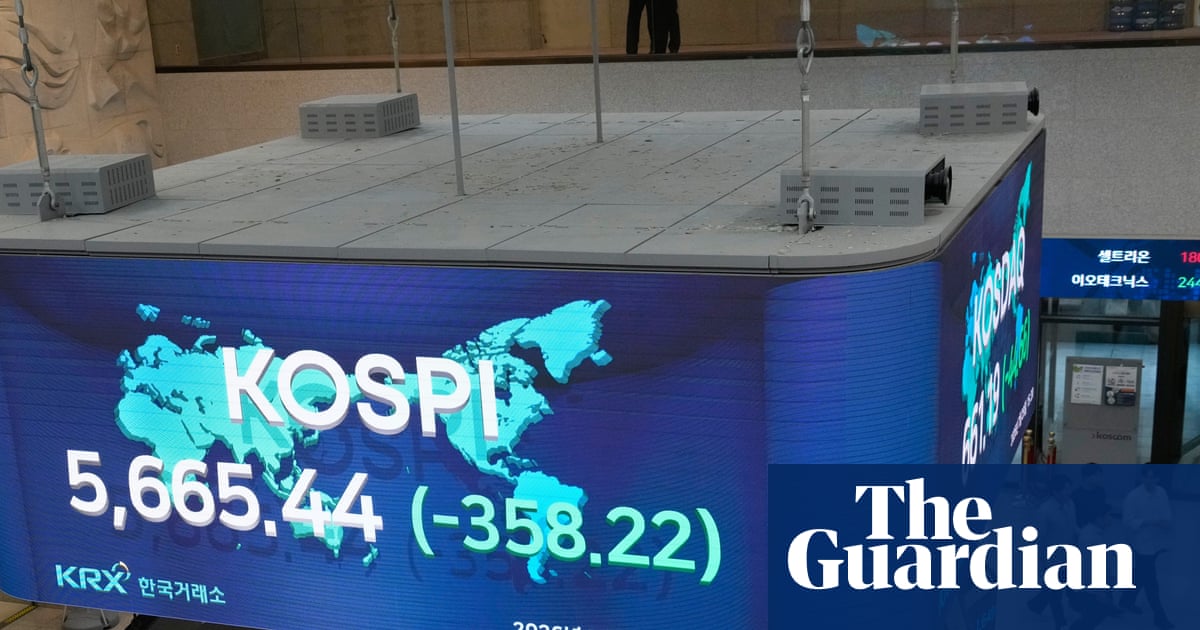
The stock prices of firms associated with artificial intelligence have experienced significant declines following disappointing financial outcomes from SK Hynix, a key player in the semiconductor industry. This downturn has resulted in a steep drop in South Korea’s stock market for the second consecutive day.
The Kospi index in Seoul, heavily influenced by semiconductor stocks, saw a decline of up to 12.6% at one point on Wednesday, building on a nearly 11% fall from the previous day, marking its lowest value since early April. This shift paves the way for a potentially unprecedented two-day decline, reflecting a staggering 40% drop from a peak achieved just over a month ago. Japan’s Nikkei index also fell by 1.5%.
In contrast, oil prices continue to rise. This increase follows an announcement from the US military regarding the interception of an Iranian missile offensive, as they collaborated with Saudi forces to target locations in Iraq used by Iran-backed militias for their launches. In early trading, Brent crude, the global benchmark, surged to $87.14 per barrel, up by approximately 3.6%.
SK Hynix, known for manufacturing the chips critical to the growth of AI data centers, reported impressive profits for the second quarter. However, these figures fell short of what investors had hoped for, triggering a sell-off that saw its shares plummet by as much as 16%. Samsung Electronics, another major chip manufacturer, also saw a further decline, with its stock dropping nearly 10%.
Together, these two companies represent over half of the Kospi's total market capitalization, giving them significant influence in the market throughout the year. Both firms had attracted substantial investment amid a global demand surge for advanced memory chips related to AI technologies.
Market analysts pointed out that the lackluster performance from SK Hynix raised alarms about the sustainability of tech firms' aggressive spending in light of the current market climate. “While SK Hynix posted strong results, in the present AI landscape, that may not suffice,” remarked Gary Tan, a portfolio manager at Allspring Global Investments in Singapore. “Investors were hoping for more substantial catalysts, especially concerning long-term agreements and returns for shareholders, to bolster a memory sector that has become central to AI investments.”
On Tuesday, shares of American chip manufacturers also fell on Wall Street, with companies like Intel, Advanced Micro Devices, Sandisk, Western Digital Corp, and Seagate Technology all experiencing declines.
Amid this slump, Apple found itself as a beneficiary; investors seeking refuge from the AI stock decline turned to the tech giant, briefly lifting its stock to surpass a valuation of $5 trillion (£3.76 trillion), making it only the second company to reach this milestone.
Shares of Taiwan Semiconductor Manufacturing Company (TSMC), the world’s largest contract chipmaker, faced a 3% drop in Taipei as well.
Experts noted that retail investors largely drove the initial surge in chipmaker stocks, many utilizing borrowed capital. While this strategy initially fueled a rally last month, it has aggravated the current sell-off as some investors opted to withdraw their funds. “After a steep decline of 10% the day before, hopes for a market recovery today dissipated, leading to panic selling and forcing many stockholders to realize losses,” said Han Ji-young, an analyst at Kiwoom Securities.
In response to the declining market conditions, South Korea’s finance minister, Koo Yun-cheol, announced that the government is considering measures to stabilize the financial market.


