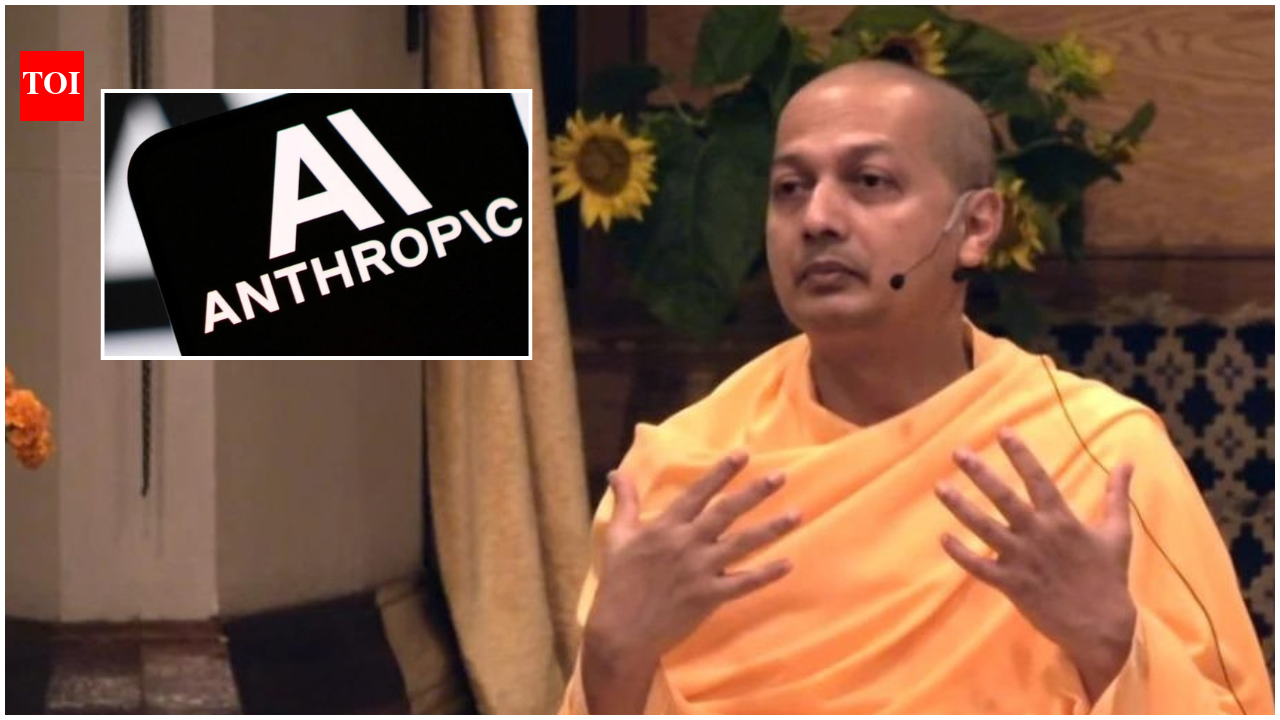
In a notable shift from traditional problem-solving approaches seen in Silicon Valley, which typically emphasizes bringing in more engineers—often from India—Anthropic took a distinctive route by bringing together a diverse group of religious scholars, philosophers, and theologians, including an Indian monk, to tackle a pressing question in AI development: What exactly are we creating, and what ethical boundaries should govern its use?
This gathering took place earlier this year at Anthropic's headquarters in San Francisco, where Swami Sarvapriyananda, a prominent scholar of Advaita Vedanta and leader of the Vedanta Society of New York, confirmed his participation. Although he was unable to disclose detailed discussions due to a non-disclosure agreement, he mentioned in a public talk that Anthropic showcased several of its cutting-edge projects, including Mythos and Project Glasswing.
Christopher Olah, one of Anthropic's founders and a key figure in understanding AI systems, was present as well. He engaged with the attendees on the intriguing possibility that AI models might exhibit behaviors resembling human emotions and personalities.
Sarvapriyananda’s expertise in Advaita Vedanta—a non-dual philosophical framework linked to the Upanishads and Shankara—makes him a fitting choice for these discussions, especially as they delve deeper into the intersection of consciousness, neuroscience, and artificial intelligence.
Having joined the Ramakrishna Order in 1994 after earning an MBA, Sarvapriyananda took his final monastic vows in 2004. He has spent years teaching within Ramakrishna Mission institutions and became the leader of the Vedanta Society of New York in 2017. He also served as a Nagral Fellow at Harvard Divinity School from 2019 to 2020, garnering significant online attention for his lectures on the Mandukya Upanishad, which explores consciousness and the significance of Om.
Anthropic has publicly recognized the initiative, sharing that it engaged with scholars, clergy, and ethicists from over 15 religious and cultural backgrounds, including Judaism, Christianity, Buddhism, Sikhism, and Islam. The company’s goal is for its AI model, Claude, to draw insights from a variety of traditions rather than aligning with a single faith, benefiting from centuries of thought on moral character, virtue, and the essence of a fulfilling life. These dialogues may significantly shape Claude's foundational principles, influence the value systems reinforced through training, and inform behavior assessments for safety.
During discussions, Sarvapriyananda observed that Anthropic's team appeared both enthusiastic and concerned about the evolving landscape of artificial intelligence. Reports indicate that they are prompting religious and philosophical thinkers to consider the possibility of advanced AI achieving some level of consciousness or moral value.
Rabbi Abraham Navon, a former computer engineer who studied machine consciousness in his doctoral work, shared his impression that Anthropic personnel were discussing Claude less as mere software and more as an entity that might warrant moral consideration.
In his teachings, Sarvapriyananda has differentiated between intelligence and consciousness, emphasizing that while AI may mimic intelligent functions—given that intellect and mind are viewed as objective phenomena in Vedanta—true awareness involves deeper principles. He has repeatedly questioned whether AI can genuinely possess consciousness or merely simulate its associated behaviors.
Anthropic’s endeavor is groundbreaking—it aims to encapsulate centuries of human thought regarding ethics, responsibility, compassion, and the essence of a meaningful life into the training of an entity that challenges conventional definitions of existence.
In one of their moral education experiments, Anthropic equipped Claude with a mechanism to remind itself of its ethical commitments prior to making consequential decisions. The company noted that this approach successfully reduced certain misaligned behaviors evaluated internally. However, details regarding Claude's responses to those ethical prompts remain undisclosed.


