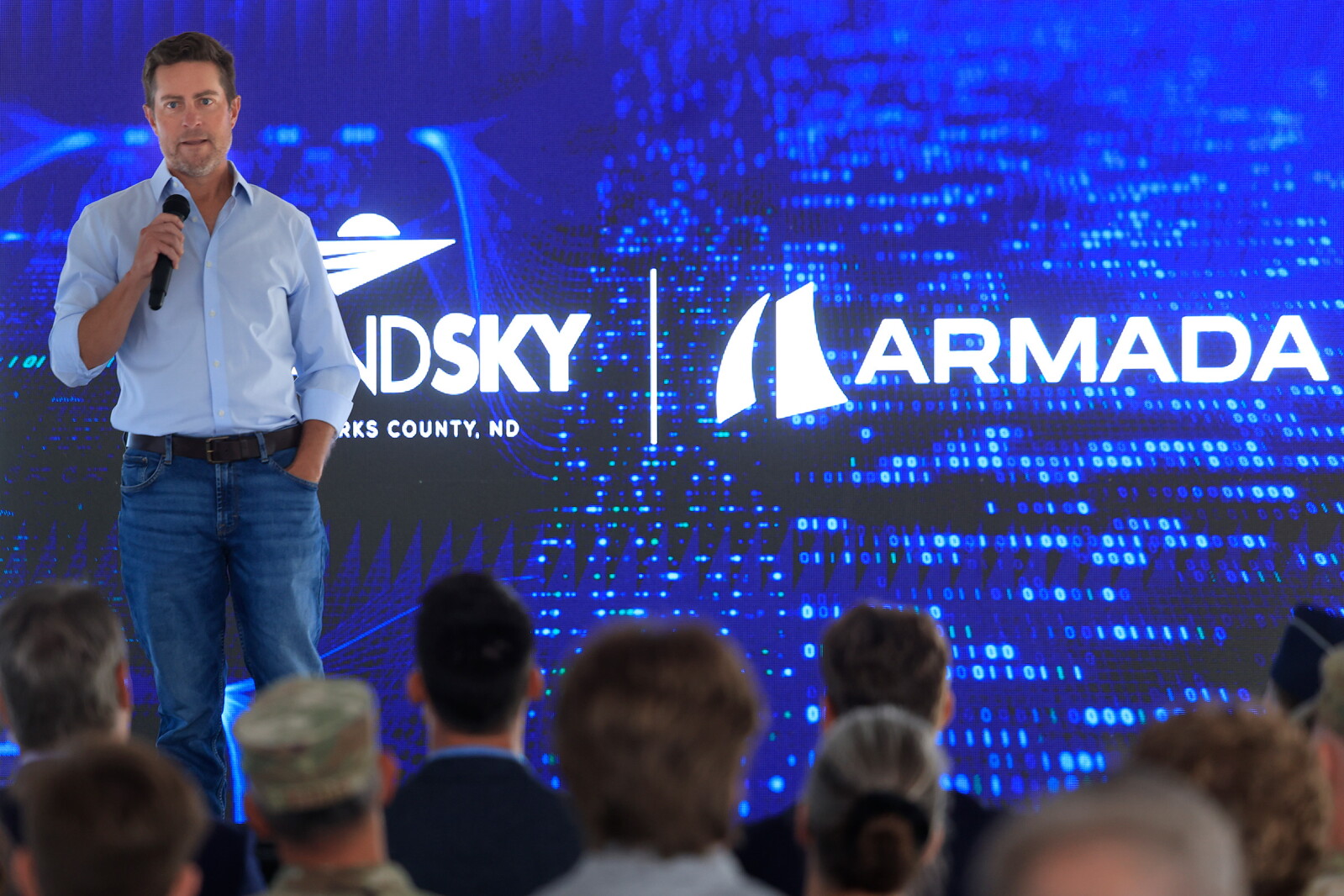
EMERADO — During an event at Grand Sky on Friday, the AI company Armada presented its latest innovation, a transportable data center called Triton. Measuring 40 feet in length, this compact center can easily be towed by a semi truck and is touted by Armada as fully operational in a variety of global environments, from the arid deserts of Saudi Arabia to the frigid landscapes of interior Alaska, where temperatures can drop to minus 50 degrees.
“This tool will not only draw in major companies like Northrop Grumman and General Atomics, but it will also inspire innovators, including college students,” remarked U.S. Senator Kevin Cramer, R-North Dakota, during the launch.
The introduction of Triton coincides closely with the first meeting of North Dakota’s AI and Data Center Committee, which gathered two days prior to discuss the increasing demands placed on energy resources by these technologies. Data centers were responsible for approximately 4-5% of energy consumption in 2024, a figure projected to rise to between 9-17% by 2030. Rep. Mike Nathe, R-Bismarck, noted that the state may struggle to meet this impending demand.
Armada's Chief Operating Officer, Jon Runyan, voiced enthusiasm for promoting the use of Triton among various tenants located in both Grand Forks and at Grand Sky. “We invite everyone, from the Air Force to General Atomics and local universities, to explore the opportunities this unit provides,” he stated. The Triton will primarily serve to gather and process data for unmanned aircraft system missions within the aviation park, with the company generously offering its use free of charge for one year.
Additionally, Armada is collaborating with the federal government on President Donald Trump’s proposed Golden Dome missile defense initiative, a project that Cramer has championed to enhance North Dakota’s role in national defense operations. Earlier in the year, Cramer backed a Senate funding bill that includes a $5 million allocation for the Perimeter Acquisition Radar Attack Characterization System at Cavalier Space Force Station, which plays a pivotal role in monitoring objects in orbit integral to the Golden Dome project.
“The Golden Dome aims to integrate both new and current technologies to establish a protective barrier against incoming threats, whether they be missiles, aircraft, drones, or autonomous robots,” stated Cramer. “This kind of integration facilitates not only the collection of data but also its rapid transmission.”
The capabilities of each Triton are contingent upon the processing power of the computers it houses, according to senior project manager Tori McCaffrey. Customers have the option to provide their own GPU and CPU or source them from suppliers through Armada.
McCaffrey emphasized that Triton is energy "agnostic," meaning it can operate using power derived from a wide array of sources, both renewable and conventional. “We can utilize stranded energy resources effectively,” she noted, providing the example of deploying Triton on an oil rig in the North Sea, where a generator is often required.
She further highlighted that Armada’s data centers stand apart from traditional facilities due to their smaller footprint and reduced energy consumption, as well as their non-reliance on water for cooling purposes, though the centers do emit noticeable sound levels.