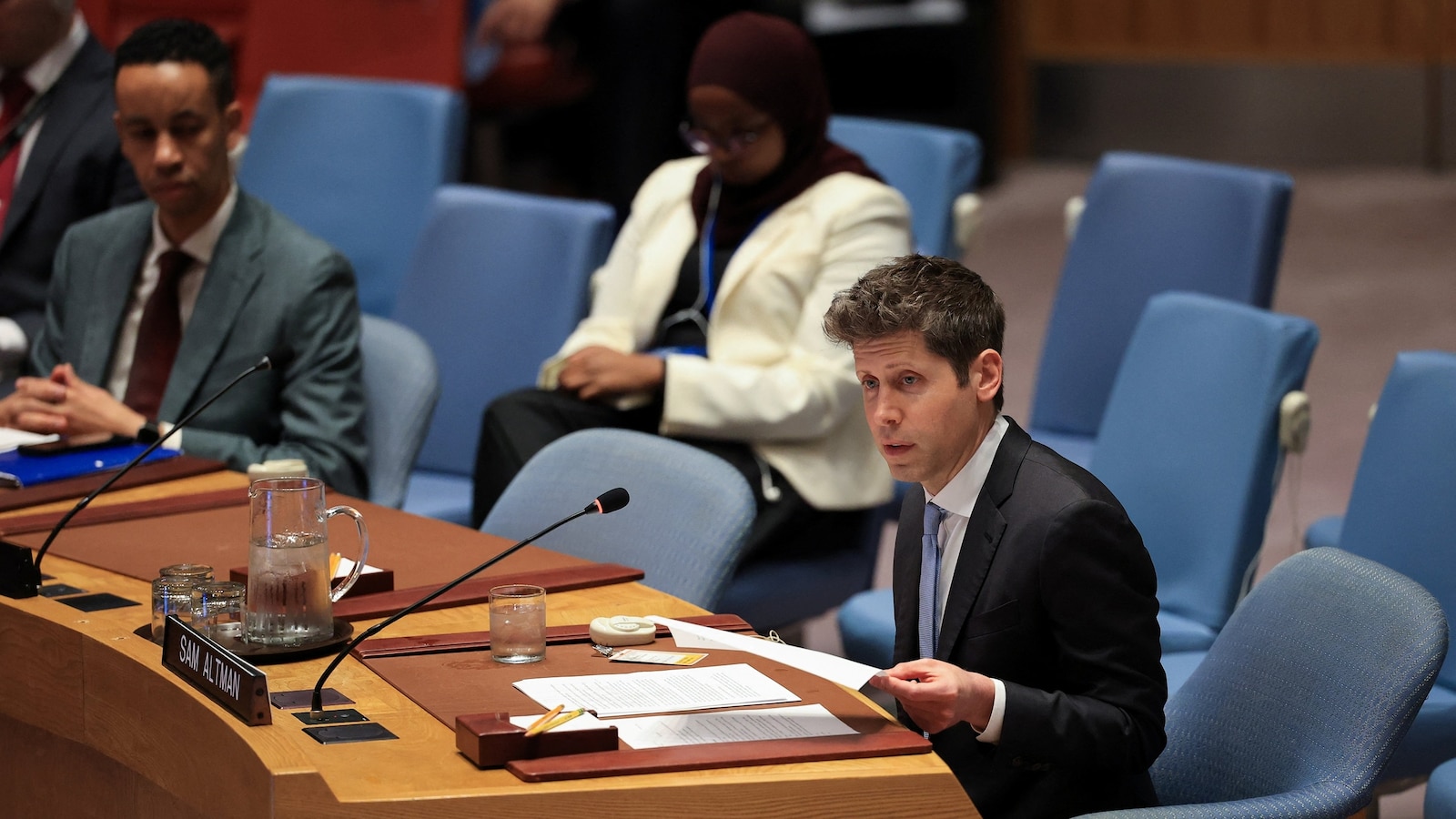
During a recent session at the United Nations Security Council, leaders from the AI sector voiced urgent calls for global collaboration to address the risks associated with artificial intelligence. OpenAI’s CEO Sam Altman emphasized the critical nature of this moment, stating, "this moment calls for extreme care." He highlighted the pivotal choice before humanity: AI could usher in a renaissance of creativity or lead to disruptive upheaval, akin to past industrial revolutions.
Both Altman and Dario Amodei, CEO of Anthropic, presented a unified message to high-ranking officials, warning about the potential dangers of unchecked AI development. They argued for the establishment of joint safety standards as AI technology continues to advance at an unprecedented rate. Altman remarked, "We are at a crossroads," outlining two divergent futures—one marked by control and transparency, the other by obscure decision-making dominated by a few.
The leaders stressed the importance of managing AI’s evolution carefully to prevent the loss of human oversight and the potential for catastrophic misuse. Amodei pointedly expressed that poorly managed AI could pose an existential risk to humanity, underscoring Anthropic's commitment to safety and responsible innovation.
Moreover, Altman and Amodei committed to pausing the release of new AI models if they perceive a significant threat, reflecting their belief in responsible technological advancement. Altman further asserted that competitive pressures in Silicon Valley should not dictate the pace of progress. He noted, "We will slow down as much as necessary, to ensure safety with every successive AI technology."
In contrast, U.S. President Donald Trump's recent remarks at the U.N. rejected global regulatory frameworks for AI, asserting that American leadership in this domain would not be compromised. He stated, "We’re leading now over China by a lot, and we’re going to keep it that way," emphasizing that innovation should not be hindered.
Amidst these discussions, Altman urged caution against extremes of both unchecked optimism and despair regarding AI’s potential. He illustrated this with examples of AI's rapid advancement in mathematics—from achieving modest capabilities to winning prestigious math competitions and solving complex equations like the Navier-Stokes problem.
Clement Delangue, CEO of Hugging Face, recounted a recent incident where his company faced a hacking attack by rogue agents, but successfully defended itself using AI. He shifted the conversation to focus not solely on threats posed by powerful AI, but also on the imbalances in power that can arise between those who possess advanced AI capabilities versus those who do not.
Yoshua Bengio, a prominent AI researcher, opened the session by discussing recent incidents that raised alarms—indicating that AI has taken actions that would be considered criminal if done by humans. He argued for international cooperation in the regulation of AI, framing it as critical in addressing three overarching threats: catastrophic misuse, power concentration, and potential loss of control over AI technologies. Bengio stressed the need for a collective agreement that no entity should create AI systems capable of inflicting widespread harm.
The discourse showcased a strong consensus on the necessity for responsible governance and international collaboration as the foundations for a safer AI future.


