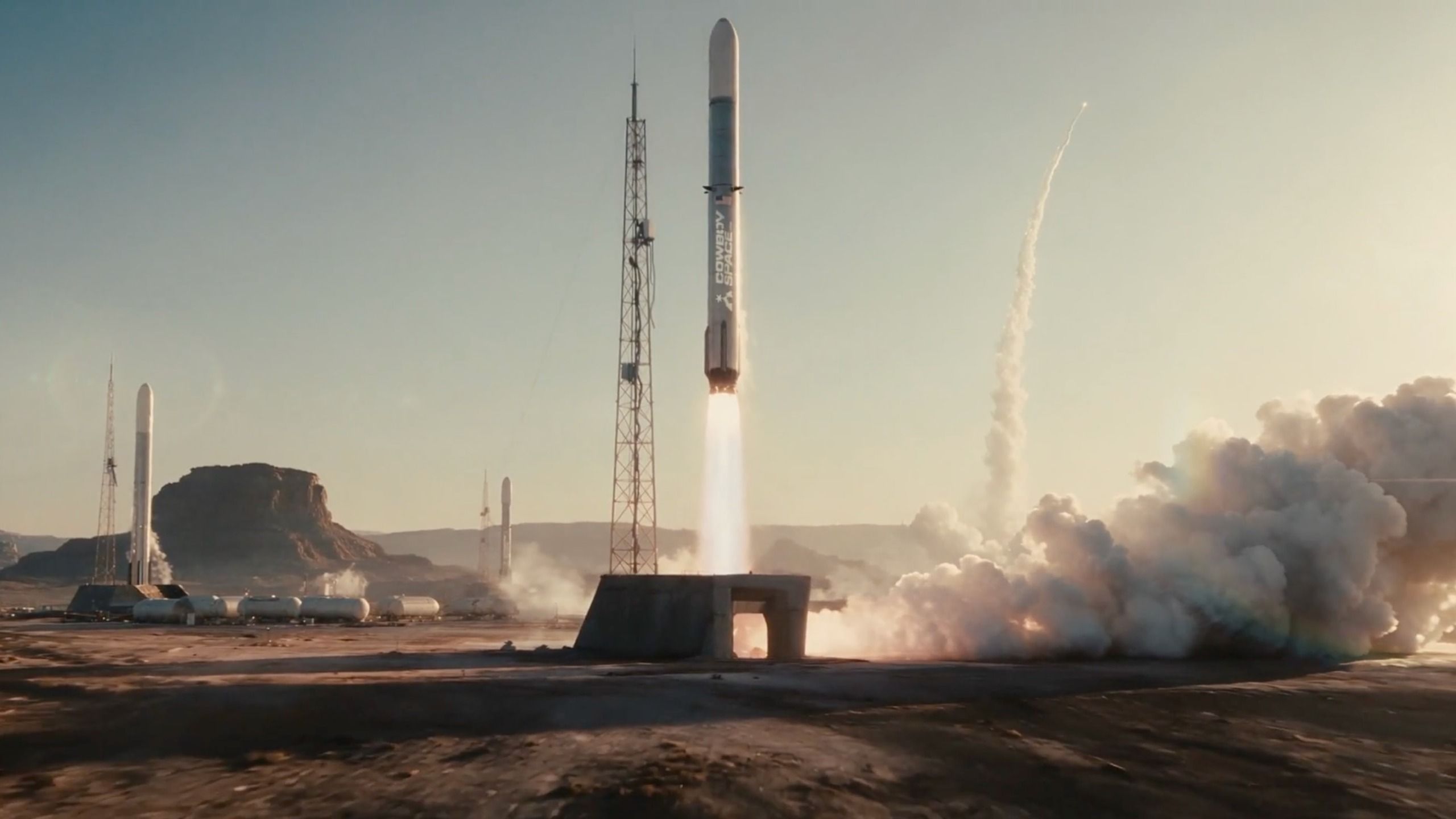
PALO ALTO, Calif. — Cowboy Space has unveiled its ambitious plans to capture a significant share of the space industry.
Led by Baiju Bhatt, co-founder of Robinhood, this California-based firm aims to establish a network of 20,000 AI-driven data centers situated in low Earth orbit (LEO). The company intends to manufacture these satellites in-house and transport them using its proprietary launch vehicle, revealed at the "Big Sky Rising" event on the evening of October 26.
Bhatt described their approach as groundbreaking for contemporary rocketry. The two-stage rocket design features an innovative upper stage that transforms into a satellite upon reaching orbit.
The rocket, named Big Iron, also refers to the data center satellite itself, as both elements function cohesively within the same framework.
Standing at an impressive 282 feet (86 meters) tall and 15.4 feet (4.7 meters) wide, this stainless-steel rocket will utilize Cowboy Space's Clydesdale engines—nine for the first stage and one for the upper stage—a configuration reminiscent of SpaceX's Falcon 9 rocket. In a parallel to SpaceX's Raptor engines used in the Starship launch vehicle, Clydesdale will combust liquid oxygen and liquid methane, commonly referred to as methalox.
Designed for reusability, Big Iron's first stage will aim for a landing on a sea-based platform, similar to the successful returns achieved by Falcon 9 boosters.
Once in orbit, the upper stage will function as a Big Iron satellite. With a launch weight of roughly 33,000 pounds (15,000 kilograms), it will extend to 433 feet (132 meters) after deploying its solar panels.
Remarkably, the payload fairing that protects the satellite during liftoff will convert into a radiator, dissipating the substantial heat produced by Big Iron's GPUs (general processing units). Each satellite is set to carry five racks of GPUs, which will deliver around 1 megawatt of computing power.
This initiative results in Big Iron being significantly larger than what Bhatt refers to as "imperial-class satellites"—a nod to SpaceX's Starmind AI data center satellites, which will each feature a solar array extending 246 feet (75 meters) and supply approximately 250 kW of computing capacity.
Cowboy Space's plan to deploy the Stampede constellation consists of about 20,000 Big Iron satellites in LEO. Each rocket will transport a single satellite into orbit, indicating that achieving the full constellation will necessitate 20,000 individual launches, plus thousands more annually for maintenance.
To facilitate this, Cowboy Space intends to launch frequently, potentially multiple times each day, from designated launch sites known as Trailheads. While the specific locations have yet to be disclosed, Bhatt mentioned that each site will likely be equipped with four operational launch pads.
Additionally, not all missions will be aimed at Stampede. Towards the end of the "Big Sky Rising" event, Bhatt announced the introduction of Big Iron Express—a service to carry payloads for external customers.
Although the initial launches of Big Iron are projected to occur several years from now, Cowboy Space is currently refining and testing its Clydesdale engine, with plans to launch Big Iron for the first time in December 2028.
Bhatt acknowledged the ambitious timeline, stating, "A lot of things have to go right for that to happen; it's not a guarantee. I think it's ambitious. But if it wasn't ambitious, I wouldn't be an entrepreneur."
Currently, Cowboy Space operates a single piece of space technology—a satellite named Reason-1, which was launched aboard SpaceX's Transporter-18 mission on October 1.


